


































When specialty tea producers and matcha exporters pitch broadline foodservice distributors (such as Sysco, US Foods, Gordon Food Service, Bidfood, or regional beverage specialists), they frequently make a fatal rookie mistake: they pitch artisan romance rather than commercial velocity. They arrive with poetic narratives about misty Japanese tea hills, multi-generation family farmers, and traditional bamboo whisks.
To a seasoned foodservice Category Manager (CM), romantic stories are completely irrelevant. Category managers manage hundreds of thousands of square feet of temperature-controlled distribution center (DC) racking. They are evaluated on strict mathematical metrics: inventory turns per year, gross margin return on inventory investment (GMROII), slotting allowance recovery, case pack dimensions, and GFSI food safety compliance.
If your commercial line of bulk matcha powder wholesale arrives in non-standard bulk boxes without GS1-128 master carton barcodes, or lacks a 24-hour mock recall protocol, the distributor's automated warehouse management system (WMS) will reject your application immediately. To successfully scale from boutique roasters into national distribution networks, manufacturers must understand the exact financial, logistical, and operational filters distributors use to evaluate new SKUs.
1. The Foodservice Margin & Financial Equation
Before testing your tea's aroma or color, category managers calculate your item's financial yield. Understanding distributor margin mechanics prevents pricing miscalculations that destroy profitability.
| Commercial Cost Component | Standard Foodservice Benchmark | Commercial Purpose & Calculation | Impact on Supplier Net Revenue |
|---|---|---|---|
| Distributor Gross Margin | 20.0% – 28.0% (Specialty Beverage) | Markup added by distributor to cover warehousing, sales commissions, and refrigerated fleet trucking. | Reduces supplier selling price ceiling to end-operator. |
| Cash Early Payment Discount | 2% 10 Net 30 | 2% discount deducted if distributor pays supplier invoice within 10 days of receiving goods. | Mandatory standard subtraction from gross invoice. |
| Spoilage & Damage Allowance | 1.0% – 1.5% off invoice | Automatic billback covering minor warehouse handling damage and carton punctures. | Standard contract line item deducted off invoice. |
| Broker Sales Commission | 5.0% on net delivered sales | Paid to local foodservice food brokers who represent your SKU to restaurant street sales reps (DSRs). | Supplier pays broker directly upon monthly distributor shipment reports. |
| Marketing Co-Op / Annual Rebates | $3.00 – $5.00 per case ($1.5%–3.0%) | Funds distributor food shows, quarterly product catalogs, and Digital Ordering Platform placements. | Billed back quarterly or deducted via credit memo. |
The CM Threshold: Category managers demand a GMROII score > 3.2. If a matcha SKU generates 24% gross margin and turns 14 times per year, it yields high GMROII, guaranteeing permanent warehouse slot retention.
2. Packaging, Master Carton & Warehouse Logistics Specs
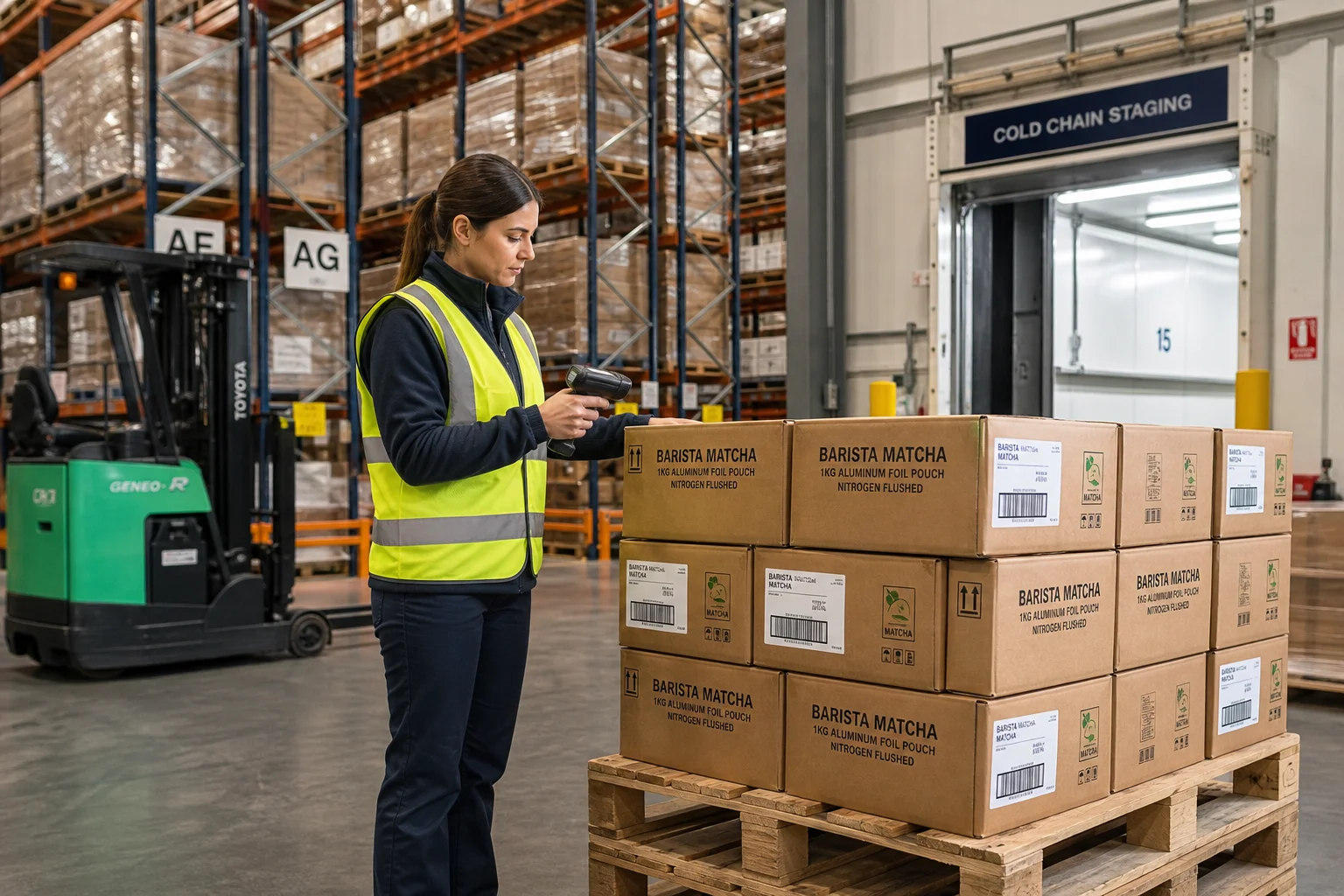
Broadline distribution centers operate on automated conveyor belts, laser barcode scanners, and high-density pallet racking. Improper packaging creates immediate operational friction.
Pack Size Architecture
- The Winning Format: 1kg (2.2 lb) aluminum foil stand-up barrier pouches with resealable zippers and tear notches.
- Why 25lb Boxes Fail: Operators cannot use 25lb bulk boxes on busy espresso bars without severe powder oxidation, moisture clumping, and waste.
- Master Case Size: Standard 10 x 1kg (10kg net / ~11.2kg gross) or 6 x 1kg case packs for specialty distributors.
Barcode & GS1 Data Standards
- Outer Case Code: High-resolution GTIN-14 / ITF-14 barcode printed on opposing case panels for forklift scanning.
- Inner Pouch Code: GS1-compliant UPC/EAN-13 barcode on every individual 1kg pouch for operator inventory tracking.
- Lot & Date Coding: Clear human-readable Julian Date / Expiration Date printed in bold ink on carton exterior.
Pallet Ti-Hi & Shelf Life
- Standard Palletization: 10 cases per tier (Ti) × 5 tiers high (Hi) = 50 cases (500kg net) per GMA 48×40 inch pallet.
- Overhang Rule: Zero carton overhang past wooden pallet perimeter to prevent corner crush during racking.
- Receiving Shelf Life: Strict requirement of ≥ 75% remaining shelf life (18+ months) upon arrival at DC receiving dock.
3. Food Safety & Regulatory Hard Gates
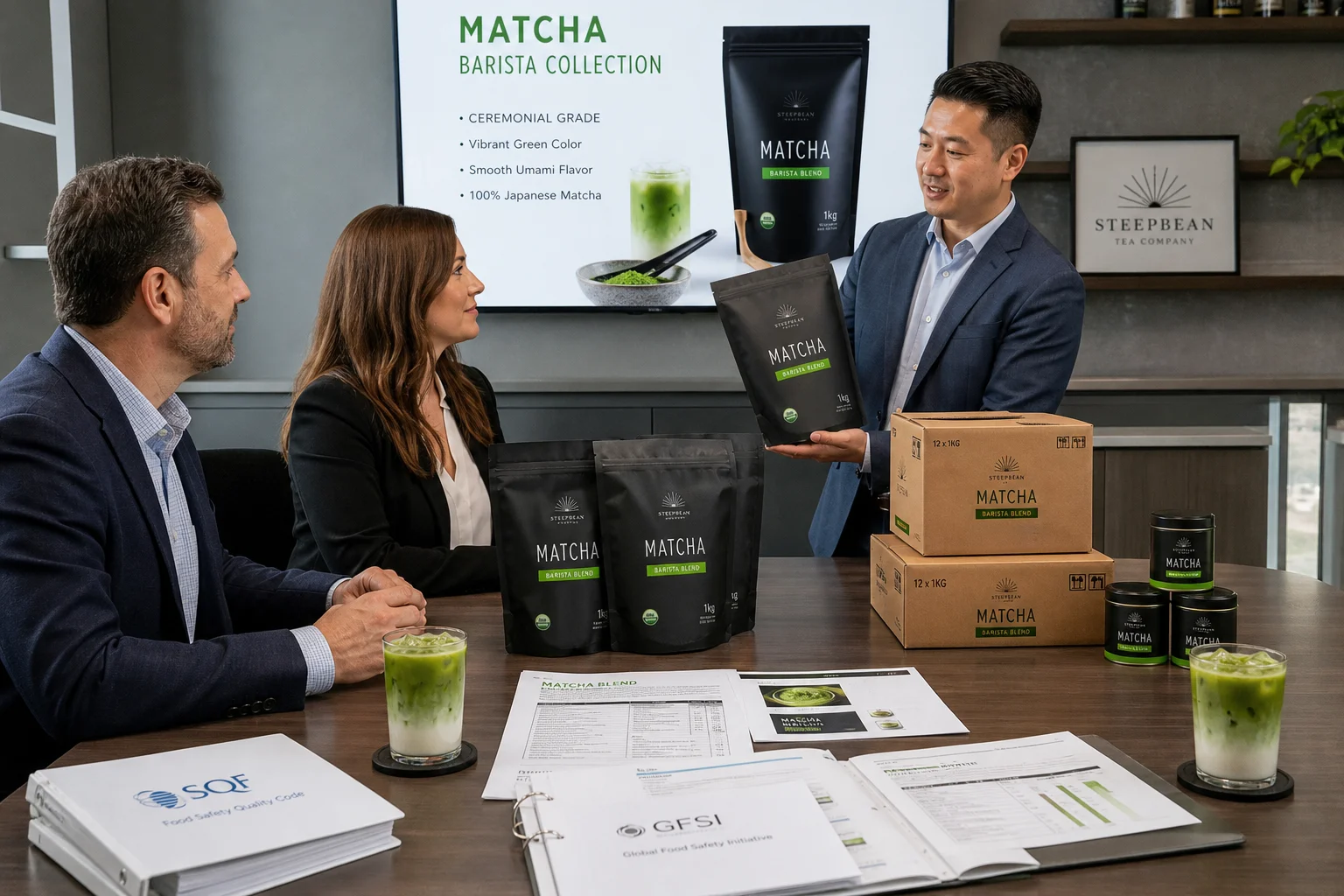
In the post-FSMA regulatory era, major distributors will not even schedule a category review without verified third-party food safety credentials. Category managers use quality compliance as an initial elimination filter.
Mandatory accredited Global Food Safety Initiative (GFSI) certification: SQF Level 2, BRCGS Grade A, or FSSC 22000 with zero critical non-conformances.
Designated Foreign Supplier Verification Program (FSVP) Qualified Agent established inside the importing territory with verified supplier audit files.
Certificate of Insurance (COI) maintaining $5M to $10M Commercial General and Product Liability, explicitly naming the distributor as additional insured.
Demonstrated 24-hour mock recall execution capability and lot-specific CoAs verifying pesticide multi-residue and heavy metal compliance from your matcha retention sample library.
4. What Makes District Sales Reps (DSRs) Love Your SKU
Getting into the distributor's catalog is only half the battle; getting their commission-driven District Sales Reps (DSRs) to actively pitch your matcha over competing beverage mixes is where real sales volume happens. DSRs favor products that solve real operational headaches for busy restaurant operators:
5. The 4-Step Commercial Pitch Playbook
Execute this systematic commercial sequence when presenting your line to regional and national broadline distributor category teams:
Pre-Sell Operator Demand Pull
Secure signed letters of intent from 3 to 5 multi-unit cafe or restaurant operators in the distributor's operating territory who commit to purchasing your SKU through their DC on day one.
Prepare Turnkey GDSN / Item Sheets
Complete standardized 1WorldSync / GDSN item setup data: gross case weights, cubic feet, Ti-Hi pallet counts, allergen declarations, and high-res GS1 product images.
Engage Foodservice Broker Network
Partner with regional beverage brokers offering 5% commission and dedicated DSR sales incentives ("spiffs" of $3–$5 per new operator drop) to drive catalog awareness.
Fund Sampling & Food Show Booths
Provide 100 free operator sample kits (250g trial pouches) and commit to exhibiting at the distributor's annual spring and fall customer buying expos.
Conclusion: Scaling from Pallet Orders to National Distribution
Transitioning from direct-to-consumer sales to broadline foodservice distribution is the single fastest way to unlock multi-container commercial scale. By shifting your presentation from romantic artisanal narratives to rigorous financial engineering, you speak the exact language distributor category managers respect:
- Predictable Margin Architecture: Protect distributor margins (20%–28%) while maintaining competitive per-cup food costs for end-operators.
- Flawless Automated Logistics: Eliminate warehouse receiving delays through precision GS1-128 master cartons, optimized pallet Ti-Hi geometry, and guaranteed shelf-life freshness.
- Risk-Free Food Safety Compliance: Shield enterprise distributors from liability with pristine GFSI audit ratings, verified FSVP agent representation, and robust vendor scorecard quality benchmarks.
Partnering with a vertically integrated bulk manufacturer who provides certified organic farming, SQF-compliant milling facilities, custom barista pack design, and transparent DDP delivered logistics provides the foundation your brand needs to dominate commercial foodservice channels.
Foodservice Distributor Matcha Onboarding FAQ
What profit margins do broadline foodservice distributors expect on commercial matcha lines?
Broadline foodservice distributors typically target gross profit margins between 20% and 28% on specialty beverage lines, in addition to standard 2% 10 Net 30 early payment discounts, 1% spoilage allowances, and negotiated marketing co-op funds.
What is the industry-standard pack size and master case configuration for foodservice matcha?
The industry gold standard is a 10 x 1kg (or 6 x 1kg) master carton containing resealable, nitrogen-flushed multi-layer barrier foil stand-up pouches with tear notches, complete with GTIN-14 outer case barcodes and unit UPC codes.
What food safety certifications are mandatory to onboard matcha with major foodservice distributors?
Major distributors mandate an accredited GFSI audit certificate (SQF Level 2, BRCGS Grade A, or FSSC 22000), a designated US/EU FSVP Qualified Agent, a $5M to $10M Commercial General and Product Liability Certificate of Insurance (COI), and multi-residue pesticide/heavy metal screening CoAs.
What is the most effective strategy to convince a distributor category manager to stock a new matcha SKU?
The most effective strategy is demonstrating 'Operator Demand Pull'—presenting signed letters of intent or confirmed recurring purchase commitments from 3 to 5 regional cafe chains or multi-unit restaurant operators ready to purchase through that specific distribution center on day one.
Why do commercial distributors reject 25lb (10kg) bulk boxes for cafe and restaurant supply?
Distributors reject 25lb bulk boxes because restaurant operators experience rapid powder oxidation, humidity clumping, and cross-contamination when scooping from open bulk containers; 1kg barista pouches preserve nitrogen freshness and fit commercial kitchen shelf storage perfectly.
What minimum remaining shelf life do foodservice distribution centers require upon delivery?
Foodservice receiving docks generally enforce a strict rule requiring at least 75% of total declared shelf life remaining (typically a minimum of 12 to 18 months of unexpired shelf life) upon physical delivery at their distribution center.
Partner with AMULYN for Turnkey Foodservice Distribution Programs
AMULYN delivers high-volume foodservice distributor solutions: custom-branded 1kg barista barrier pouches, full GS1 barcode integration, GFSI/SQF audit documentation, and competitive delivered DC pricing. Contact our commercial enterprise team to evaluate our foodservice distributor program and request distributor sample cases.
Request Foodservice Distributor Program Kit


