























In high-volume botanical powder commerce, international tea traders and beverage brand purchasing directors face an unavoidable agricultural reality: matcha is a living, seasonal, and fragile commodity. A spring first-flush harvest yields an electric emerald powder loaded with L-theanine and low in astringent catechins. By autumn, or across different harvest years, natural soil, temperature, and shading variations inevitably trigger subtle shifts in powder color, grain distribution, and flavor balance.
When an overseas beverage chain commits to an annual contract for 15 metric tons of bulk matcha powder wholesale, their executive R&D team expects every 500kg shipment delivered across the 12-month cycle to match the exact sensory signature approved in their initial development lab. If a container arrives with even a minor hue deviation or a slight rise in bitterness, catastrophic commercial fallout ensues: rejected shipments, emergency air-freight replacements, brand damage, and contested invoices.
Without an institutionalized Matcha Retention Sample Library and Quantitative Reference Standard System, trading houses and brand QA departments are defenseless in commercial disputes. Was the delivered batch out of specification? Did the tea oxidize during ocean transit under poor Incoterms trade terms? Or did the customer store the powder improperly at ambient store temperatures? This guide establishes the engineering protocols required to construct, archive, calibrate, and utilize a professional matcha retention library.
1. Why Sample Retention is the Ultimate Risk Shield for Traders
In B2B contract manufacturing and commodity trading, retention samples are not merely marketing souvenirs—they are binding legal and technical instruments. A structured sample repository fulfills four vital commercial functions:
Provides an uncompromised physical reference to prove whether delivered goods matched factory pre-shipment specifications or suffered post-delivery handling abuse.
Allows blending masters and QA teams to benchmark incoming seasonal harvest lots against the approved "Golden Standard" to adjust shading and blending ratios.
Enables real-time and accelerated stability testing over 18 to 24 months to validate shelf-life claims, barrier packaging efficacy, and nitrogen flushing integrity.
Feeds historical batch variance data directly into your matcha vendor scorecard evaluation framework to reward consistent growers and penalize drifting suppliers.
2. Degradation Physics & Dual-Zone Sample Architecture
Standard room-temperature file cabinets are fatal to matcha samples. Because matcha particles are micro-milled (typically with D90 ≤ 15μm), their massive specific surface area exposes delicate chlorophyll molecules, catechins, and amino acids to rapid oxidation. At 25°C, enzymatic and photolytic degradation converts bright green magnesium-chlorophyll into dull olive-brown pheophytin within weeks, rendering ambient samples useless as reference standards.
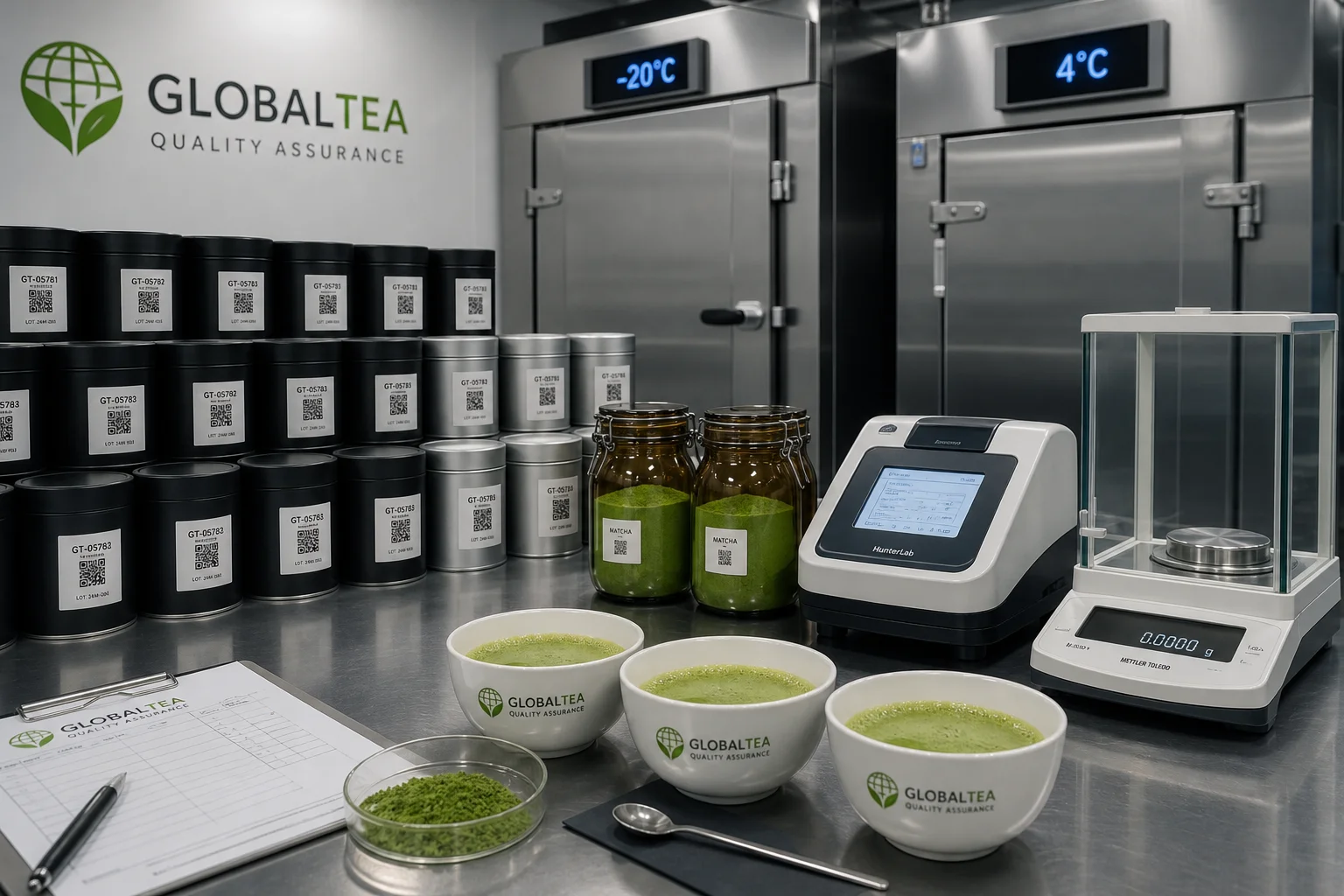
Zone A: Master Archive (-20°C)
- Purpose: Legal & technical golden baseline; opened only for formal contractual disputes.
- Storage Env: Deep-freeze chamber maintained strictly at -18°C to -20°C.
- Packaging: Triple-laminate aluminum foil bags, vacuum sealed with food-grade N2 flush (O2 < 0.5%) and oxygen scavenger sachet.
- Retention Span: 24 months (full shelf life + 6-month buffer).
Zone B: Working Library (4°C)
- Purpose: Routine daily QA testing, batch release matching, and customer pre-shipment approvals.
- Storage Env: Dedicated dark cold-room or lab refrigerator at 2°C to 4°C (RH < 45%).
- Packaging: Hermetically sealed amber glass jars or screw-top aluminum canisters with silicone gasket seals.
- Retention Span: 3 to 6 months (frequently rotated working stock).
Zone C: Client Pre-Shipment Vault
- Purpose: Co-signed customer approval samples representing mutually agreed batch targets.
- Storage Env: Dark climate-controlled chamber at 4°C.
- Packaging: Dual-split 100g sample sets (1 retained internally, 1 dispatched to client for sign-off).
- Retention Span: Duration of client master service agreement.
Never open a frozen retention sample immediately upon removal from cold storage! If a -20°C sample bag is opened in a 22°C laboratory with 55% relative humidity, ambient water vapor instantly condenses onto the micro-fine powder, raising internal moisture above 6.0% and causing irreversible clump formation and rapid browning within minutes.
Step 1: Transfer sealed foil pouch from -20°C freezer to 4°C refrigerator for 12 hours.
Step 2: Transfer sealed pouch to ambient lab bench (20°C–22°C) for 4 to 6 hours unopened.
Step 3: Verify package surface temperature exceeds room dew point (T_surface > T_dew + 3°C) before breaking the vacuum seal.
3. Calibrating Quantitative Reference Standards
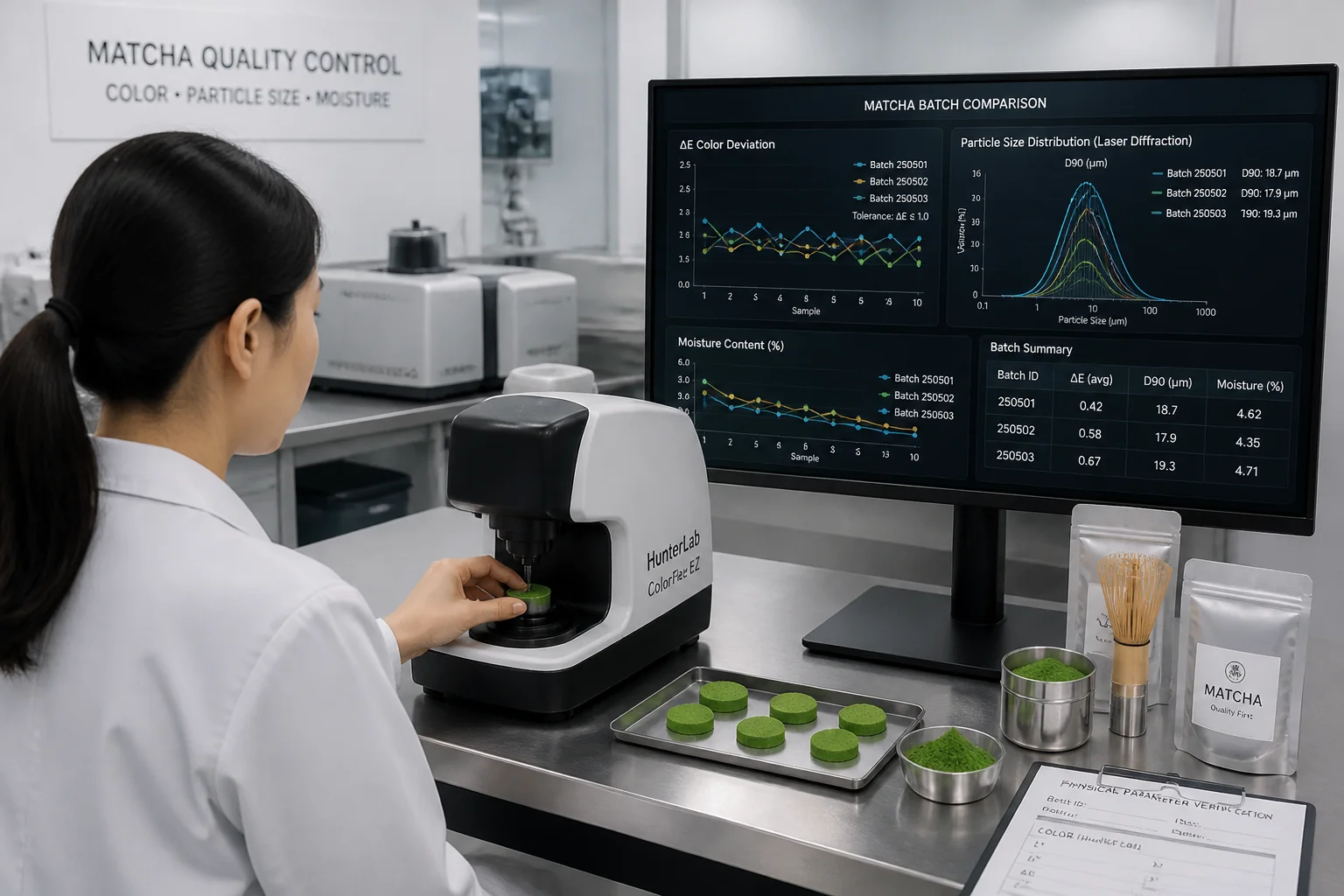
Human sensory cupping is inherently subjective and prone to palate fatigue. A commercial sample library must link every physical retention lot to an immutable digital certificate of analysis (CoA) built on four instrumental pillars.
| Quality Dimension | Testing Instrument & Method | Ceremonial Grade Threshold | Barista / Cafe Grade Threshold | Dispute Variance Limit |
|---|---|---|---|---|
| Color Space (Hunter Lab) | Benchtop Spectrophotometer (D65/10°, pressed powder disc) | L* ≥ 52.0, a* ≤ -18.5, b* ≥ 28.0 | L* ≥ 48.0, a* ≤ -14.0, b* ≥ 26.0 | Delta E ≤ 1.2 (Strict) / ≤ 2.0 (Barista) |
| Particle Size (D90 / D50) | Laser Diffraction Particle Size Analyzer (Dry dispersion) | D90 ≤ 14.0μm, D50 ≈ 5.0–6.5μm | D90 ≤ 18.0μm, D50 ≈ 7.0–9.0μm | D90 Variance ≤ ±1.5μm |
| Moisture Content | Halogen Moisture Analyzer / Karl Fischer Titration | Moisture ≤ 4.0% | Moisture ≤ 5.0% | Moisture Variance ≤ ±0.5% |
| Water Activity (a_w) | Chilled Mirror Dew Point Water Activity Meter | a_w ≤ 0.28 | a_w ≤ 0.35 | Max Limit a_w ≤ 0.40 |
| L-Theanine Content | High-Performance Liquid Chromatography (HPLC) | ≥ 2.2% (22.0 mg/g) | ≥ 1.2% (12.0 mg/g) | Variance ≤ ±10% of Baseline |
| Total Catechins / EGCG | HPLC Spectrophotometry | 10.0% – 13.5% | 13.0% – 16.5% | Variance ≤ ±8% of Baseline |
Where Delta L* measures lightness, Delta a* measures emerald green-to-red shift, and Delta b* measures yellow-to-blue shift.
Commercial Rule: If Delta E is below 1.0, the human eye cannot distinguish the color difference in milk suspensions. If Delta E exceeds 2.5, beverage customers will perceive the color shift in iced lattes immediately.
4. Master Sample Logbook & Traceability Matrix
A sample library is only as reliable as its cataloging metadata. Every incoming lot must be logged with a unique alphanumeric batch identifier linked to complete upstream agronomic and downstream processing data.
5. 4-Stage Protocol for Settling Batch Drift Claims
When an enterprise buyer claims that a delivered shipment deviates from their contract specification, executing this objective protocol resolves disputes with scientific certainty:
Triangulate Physical Samples
Assemble three distinct physical sets: (1) Approved Golden Pre-Shipment Sample, (2) Retained Master Archive Lot Sample (-20°C), and (3) Customer's Returned Field Sample.
Instrumental Delta E Testing
Perform spectrophotometer measurements across all three sets under standardized D65 daylight illuminants to determine if color shift occurred at origin or during customer storage.
Moisture & Oxygen Audit
Measure moisture content and headspace oxygen in the customer's returned container. Elevated moisture (>5.5%) proves post-delivery ambient seal leakage rather than factory defect.
Blind Triangular Cupping
Conduct ISO 3103 sensory triangular taste tests with a 5-member certified sensory panel to confirm whether flavor deviations are statistically significant.
By comparing the retained Master Archive lot against the customer's returned package, traders can immediately isolate whether quality degradation occurred due to factory processing variance or field abuses such as improper store handling detailed in our matcha cold chain and counter storage handling guide.
Conclusion: Turning Quality Control into a Commercial Asset
In the competitive global market for commercial green tea ingredients, an institutional sample library transforms quality control from a reactive cost center into an active sales and risk-management asset. By combining deep-freeze master preservation, standardized dew-point thawing protocols, and instrumental Hunter Lab colorimetry, traders and brand procurement teams achieve three decisive advantages:
- Zero Subjectivity in Quality Disputes: Replace emotional client complaints with unassailable instrumental Delta E data and sealed archive comparisons.
- Flawless Annual Repeat Ordering: Enable multi-unit franchise systems to maintain uniform beverage color and flavor across multi-ton seasonal harvests.
- Full Supply Chain Accountability: Isolate upstream milling variances from downstream logistics failures, safeguarding profit margins established in your matcha cost per cup calculation guide and ensuring seamless execution for seasonal menu rotations.
Partnering with a vertically integrated manufacturer that maintains full lot archiving, certified organic cold-chain warehousing, and transparent CoA documentation gives your beverage brand the technical foundation required to scale with absolute consistency.
Matcha Sample Library & Reference Standards FAQ
Why is an institutional sample retention library essential for bulk matcha trading?
An institutional sample retention library provides an immutable, physical baseline to arbitrate client quality complaints, verify seasonal batch drift, track shelf-life degradation, and ensure annual multi-ton repeat orders maintain consistent sensory and physicochemical profiles.
What is the optimal storage temperature and packaging for archived matcha retention samples?
Archived Master Retention Samples should be stored in deep-freeze chambers at -18°C to -20°C inside nitrogen-flushed, multi-layer aluminum trilaminate foil pouches with oxygen absorbers to halt chlorophyll pheophytin conversion and aromatic volatile loss.
How should frozen matcha retention samples be thawed without causing condensation damage?
To prevent condensation shock, sealed frozen sample pouches must undergo a staged equilibration protocol: transfer from -20°C to a 4°C refrigerator for 12 hours, then stand unopened at room temperature (20°C to 22°C) for at least 4 to 6 hours until package surface temperature exceeds the room dew point.
What quantitative thresholds define acceptable batch-to-batch color deviation for commercial matcha?
Using a calibrated spectrophotometer (Hunter Lab scale), acceptable batch-to-batch color deviation (Total Color Difference Delta E) is strictly capped at Delta E ≤ 1.2 for ceremonial grades and Delta E ≤ 2.0 for commercial barista and food service grades.
How long should tea traders and brand QA departments retain commercial lot samples?
Commercial lot retention samples should be maintained for the stated commercial shelf life plus a 6-month buffer (typically 18 to 24 months total) to cover inventory transit, customer warehouse holding, and end-consumer consumption cycles.
How do traders use the sample library to settle client batch drift claims objectively?
Traders perform a three-point triangulation audit comparing the pre-shipment Golden Sample, the retained Master Lot Sample, and the customer's returned field sample using instrumental Delta E colorimetry, moisture titration, and blinded triangular sensory cupping.
Request Calibrated Matcha Reference Standards & Grade Evaluation Kits
AMULYN provides certified multi-lot matcha calibration sample sets with full HPLC chemical assays, Hunter Lab colorimetric coordinates, and laser diffraction particle size curves. Partner with our food science QA team to build custom golden reference standards for your beverage chain or import brand.
Request QA Calibration Sample Kit


