
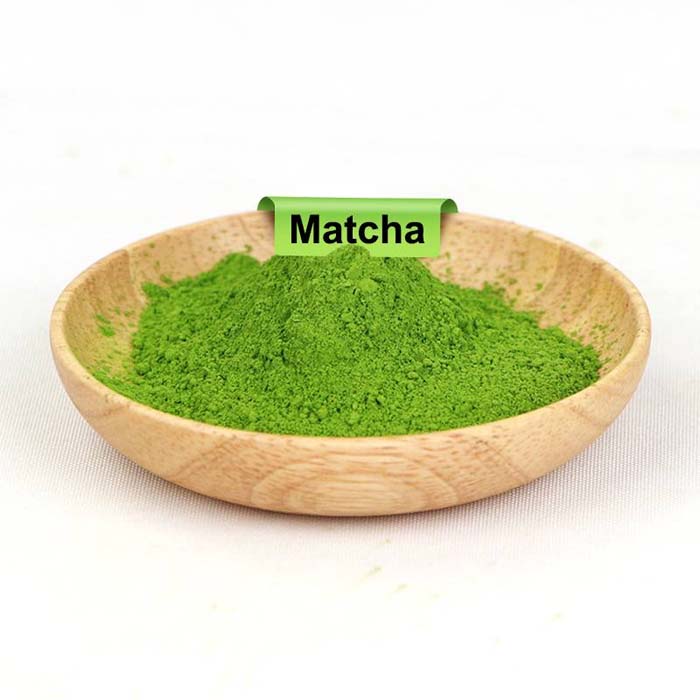





















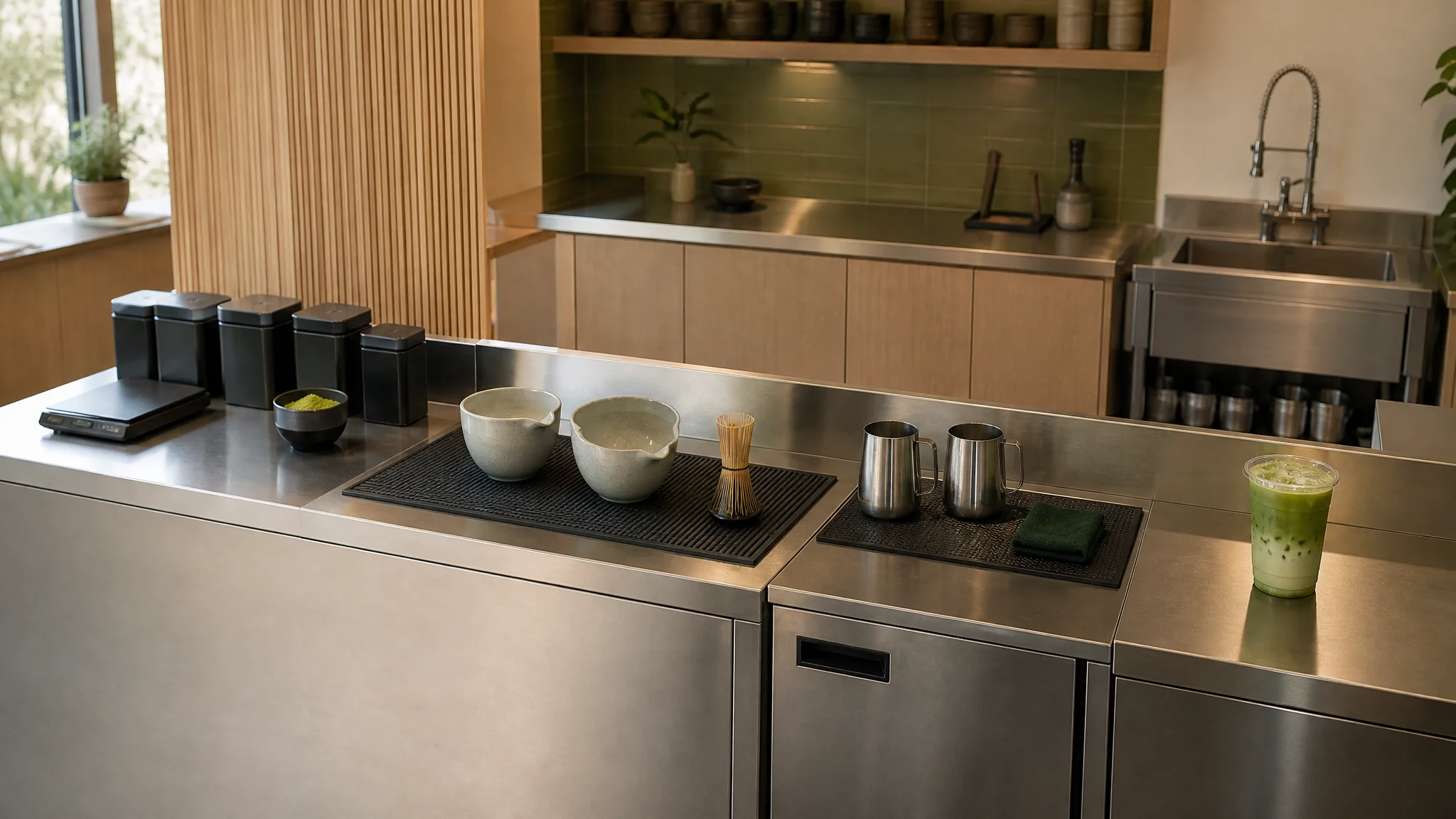
A high-volume matcha station is a controlled sequence, not a collection of tools. Give powder preparation, wet mixing, cold assembly and handoff distinct homes. Separate dirty returns from finished drinks, assign ownership at every handoff, and train staff against one recipe version. Then size the station around its slowest shared resource, rather than the fastest drink a skilled barista can make.
The queue is growing, but the whisk is not necessarily the problem. One person is searching for a sieve. Another is waiting for the same milk refrigerator. A third is asking whether a cup is oat or dairy. Everyone is moving; completed drinks are barely moving at all. These are layout and information failures that a faster mixer cannot solve on its own.
This guide is for boba shop owners, cafe managers and beverage teams building a repeatable matcha program. It connects beverage-grade matcha powder selection to the work that follows: measuring, mixing, replenishing, cleaning and teaching. The objective is consistent saleable cups, not impressive-looking equipment or an unsupported cups-per-hour promise.
How to use the numbers: All capacity calculations, portion examples and training thresholds below are explicitly proposed planning scenarios, not market averages or measured results from your store. Replace them with your recipes and time studies. Referenced preparation observations are supplier/operator guidance, not controlled productivity trials. Hygiene recommendations do not replace the food-safety plan and requirements applicable to your location.
1. Measure peak demand before buying another whisk
Daily matcha sales help plan inventory, but they hide the service challenge. Pull orders for short peak intervals and count drinks, not tickets: one ticket may contain several beverages. Split the sample into iced, hot, layered, extra-topping and modified-milk orders. Include app orders in the same view; they still consume the same bar capacity.
Record order acceptance, production start and handoff separately. Acceptance-to-start is queue time; start-to-handoff includes preparation and internal waiting. A station can improve hands-on preparation while customer waiting becomes worse because unfinished work accumulates upstream. Observe a representative rush, not just a rehearsed demonstration with ingredients already arranged.
Use a simple capacity test
Serial capacity (cups per hour) = 3,600 ÷ average seconds of work per cup
Worked planning scenario: A shop receives 24 matcha drinks in 15 minutes. That is 96 drinks per hour if the pace continues, requiring one completed drink every 37.5 seconds. If one operator performs 60 seconds of non-overlapping work per drink, theoretical capacity is only 60 drinks per hour. Reorganizing an attractive shelf will not close that gap unless it removes real work or enables safe parallel work.
Now suppose a time study supports two dedicated roles: tea preparation takes 24 seconds per cup, while assembly and handoff take 30 seconds. Their theoretical capacities are 150 and 120 cups per hour. The line ceiling is the slower role: 120, not 270. Demand of 96 cups uses 80% of that theoretical ceiling. Replenishment, cleaning, variable orders and equipment contention reduce the usable margin; they do not disappear from the model.
Before adding a person, identify the actual constraint. It might be the shared water dispenser, ice access, a sealing machine or hot-milk service. A worker cannot create parallel capacity if both people still wait for one device. Recheck the bottleneck after every change: improving tea preparation can move the queue into assembly.
2. Give every movement a destination
Map the path of a drink from ticket to pickup, then separately map powder replenishment, refrigerated ingredients and dirty tools. These routes need not be perfectly straight, but they should be understandable without verbal negotiation. Keep frequently used tools within a comfortable working reach, and test the layout with the actual staff who will use it.
- 1 / Ticket & cup
- 2 / Dry dose
- 3 / Wet mix
- 4 / Cold assembly
- 5 / Check & handoff
Separate return route: used utensils → designated dirty landing → wash, rinse and sanitize as applicable → air-dry → clean storage. Replenish from the rear or side where possible, not across open drinks.
| Zone | What belongs here | What must not interfere |
|---|---|---|
| Order identification | Ticket display, cup labels and recipe reference | Unmarked cups entering assembly; paper crowding a wet surface |
| Dry dosing | Scale, protected working powder container, dry scoop and sieve | Steam, rinse splash, wet spoons and milk pitchers |
| Wet preparation | Approved water source, mixing vessels, whisk or rated mixer | Cross-body hot-water carrying; power cords through wet work |
| Cold assembly | Refrigerated milk access, ice, sweetener and topping measures | Fridge doors blocking a teammate or finished-cup landing |
| Finish and release | Lid or sealer, order check and customer-facing handoff | Used tools, returns or new unlabelled work |
| Reset and returns | Dirty landing, cleaning supplies and drying/storage route | Dirty-to-clean crossing; treating a quick rinse as full cleaning |
A handwashing sink is not a utensil dump or a storage shelf. Keep it accessible and preserve required separation from exposed food. Likewise, a pitcher rinser is a convenience, not a substitute for the cleaning and sanitizing process your operation requires. These boundaries matter more than whether the station looks symmetrical in a photograph.
3. Choose the layout that fits the work, not the room photograph
Straight-line counter
A useful starting point when drinks can move in one direction. Put dry preparation upstream, assembly downstream and pickup at the end. Test whether the operator must repeatedly walk back for cups or lids.
L-shaped station
The turn can separate dry and wet tasks, but a deep corner can become dead storage. Put high-use items where staff can reach them without leaning over open containers.
Parallel work cells
Useful when tea preparation and assembly have distinct owners. Provide an identified handoff position; duplicate a resource only when observation confirms that sharing it creates a queue.
Mock up the station with tape and empty vessels before ordering fixed joinery. Open every undercounter door. Pull out the waste bin. Move a refill container through the route while another person assembles a drink. Simulate a dropped utensil and a delivery pickup. A layout that works only when nobody replenishes or cleans is not ready for service.
Do not adopt a universal counter length, aisle width or number of baristas from an online diagram. Equipment clearances, ventilation, electrical supply, plumbing, accessibility and local requirements belong in a site-specific plan with the relevant professionals. This article describes process adjacency, not a permit-ready installation.
4. Buy equipment against a defined operating problem
The question is not “Which tools make the bar look professional?” It is “Which task needs a more repeatable result?” A scale addresses dose variation; a second mixing vessel may eliminate a wash-and-wait interruption; a more powerful mixer helps only if mixing is the bottleneck and its cleaning burden is acceptable. Use the matcha kit essentials guide to identify tool functions, then assess their suitability for repeated commercial use rather than buying a retail kit unchanged.
For manual preparation, compare a matcha bowl versus a regular bowl against your own pouring and cleaning tasks. Check whisk clearance, stable placement, inspectable surfaces and controlled pouring. A spout can help transfer liquid, but the bowl still needs to work with the operator's hand position and your cleaning procedure.
| Tool or system | Selection test | Acceptance check |
|---|---|---|
| Powder scale | Capacity, readability, stability and cleaning suitability for the approved dose | Repeat the same weighed sample and follow the manufacturer's accuracy-check procedure |
| Whisk and mixing vessel | Comfortable technique, complete access and inspectable surfaces | No persistent clumps; tools remain serviceable and cleanable |
| Electric mixer or blender | Permitted liquid temperature, operating volume and dismantling procedure | Test texture, retained product and cleaning time, not just motor power |
| Water and cold storage | Recovery under repeated use and practical access during the rush | Measure at the point of use under operating conditions |
| Dispensing and labels | Repeatable portioning, clear identity and cleanable nozzles | Check actual delivered mass; labels survive the work environment |
Run the same equipment trial with the wholesale matcha powder you intend to buy. Powder behavior in your recipe is more useful than assuming every product sold under a similar grade name needs the same mixing routine. If you change the milk base, test dispersion and texture again; the oat powder range is a relevant formulation starting point, not a drop-in recipe guarantee.
5. Put the recipe where the decision happens
A recipe saved in a manager's folder does not control the bar. Place the approved working version at the preparation point and include its revision date, product identity, cup format, ingredient quantities, preparation method and release checks. Do not let a handwritten shortcut outlive the recipe it was meant to simplify.
Use a single base recipe plus clearly documented variants. Specify how reduced sweetness, alternative milk, extra matcha and toppings change the build. “Less sweet” should not secretly reduce the tea dose; “extra matcha” should not be an unmeasured heap. Cup size is a serving container, not a reliable measure of milk when ice and toppings also occupy it.
Proposed pilot recipe, not a universal standard: trial 3.0 g matcha, 45 g water, 160 g milk, 10 g syrup and 100 g ice for an iced latte. Test the resulting fill in the chosen cup with lid clearance. Adjust flavor and serving size during development, then issue a fixed version. If the powder supplier recommends a water-temperature starting point, record it and validate it in the finished drink.
The card should explain the sequence: identify the order; weigh and sift powder; measure water; mix until evenly dispersed; verify no dry pockets; assemble the measured cold ingredients; finish; check the ticket. Matcha is dispersed in the drink, so texture and settling need attention. “Whisk until dissolved” is not a useful training instruction.
Barista Magazine's preparation guide (May 2025), drawing on Ippodo's advice, emphasizes sifting and whisking technique and gives about 82°C as a water-temperature starting point. That is guidance to taste-test, not a universal temperature limit or a sterilization step. Measure water where the recipe uses it, not just the dispenser's display.
Add a reference photograph taken under the shop's own lighting, but do not judge quality by color alone. Include a sensory description of the approved drink: tea intensity, sweetness, texture and finish. A photo cannot reveal an incorrect syrup dose or a gritty mouthfeel.
6. Choose batching deliberately—and calculate the dose correctly
Fresh whisking, advance dry portioning and short-run liquid batching solve different problems. Fresh preparation preserves flexibility but retains more work at the order point. Dry portions move weighing out of the rush without creating a wet holding step. A liquid batch moves mixing upstream, but adds cooling or cold preparation, identification, storage and remixing controls.
Five Senses' cafe batching trial, published October 21, 2025, compared cold-water concentrate, hot-water concentrate and a premixed milk drink. Its panel preferred the hot-water method in that trial and noted settling and sensory change over time. That is useful preparation evidence, not a microbiological shelf-life study or proof that every matcha behaves identically.
| Method | Work shifted away from the rush | Control added | Choose it when |
|---|---|---|---|
| Whisk to order | Little mixing work | Repeatable technique and tool availability | The product experience and demand support it |
| Pre-portioned dry powder | Weighing and some handling | Protected portions, identification and dry storage | Weighing causes delays but wet batching is unnecessary |
| Short-run tea-and-water batch | Repeated per-cup mixing | Batch ratio, validated holding, uniform suspension and measured output | Observed demand can use the batch within the approved window |
| Premixed milk-and-tea batch | More assembly work | Milk-specific food safety, allergens and reduced customization | A controlled menu justifies the added constraints |
Specify concentration by mass, not by the bottle's appearance
Required concentrate portion = target powder dose ÷ powder mass fraction
Mass-balance example: mix 30 g powder with 450 g water, with no evaporation, spill or other addition. Total batch mass is 480 g; powder fraction is 30 ÷ 480 = 6.25%. A 48 g portion contains 3.0 g powder if the suspension is uniform. The theoretical yield is ten portions. A 48 ml dose is not automatically equivalent: volume requires a separate calibration.
If homogeneous concentrate remains in the mixing vessel, available yield falls but the concentration of what was transferred does not automatically rise. If water evaporates, water is added or powder is selectively lost, the concentration changes. Record these events rather than quietly topping up a partly used bottle. Stir or agitate by the approved method before dosing because settling makes the first and last portions different.
Assign every batch an ingredient identity, recipe version, preparer, preparation time, storage instructions and approved discard point. Size batches around expected demand within that validated window. Never turn “we used it the same day” into a food-safety guarantee, and never infer a safe room-temperature holding period from good color or smell.
7. Assign ownership before the rush begins
Two people working quickly can still produce a slow line when neither owns the next decision. The tea maker assumes the milk has been checked; the assembler assumes the tea maker read the modification. Prevent that ambiguity with a defined handoff: an identified cup, the correct tea portion and a readable order reference. Ownership transfers when the receiving person accepts the work, not when somebody sets a bowl down.
| Service mode | Who owns what | Control to protect |
|---|---|---|
| One operator | Own the full drink sequence; schedule protected replenishment and cleaning pauses. | Do not start so many cups that identity, cold storage or tool hygiene becomes unmanageable. |
| Two operators | Tea maker: dose, water and mixing. Assembler: milk, ice, toppings, finishing and final ticket check. | One marked handoff position; a visible signal when downstream work is full. |
| Additional support | Runner: approved replenishment, stock retrieval and dirty-tool transfer. Shift lead: exceptions and queue management. | Do not let refill activity cross exposed drinks or leave new ingredients unidentified. |
Use a short spoken readback for exceptions: order identity, milk choice, sweetness change and additional tea. Keep the written ticket as the source of truth; verbal memory should not replace it. Put complicated orders into a visible exception position rather than holding a half-built cup over the standard line while asking for help.
Limit unfinished work at the handoff
If the assembly area is full, tea preparation should not keep generating unidentified bowls. Set the work-in-progress limit to the number of clearly marked, hygienic holding positions the station actually has. This is a physical control, not a productivity contest. It protects order identity and exposes the downstream bottleneck early.
When adding a layered item such as ube coconut matcha, give its puree and topping steps an explicit owner. Test the added spoon, ingredient container and cleaning movement during the rush simulation. A drink that shares matcha powder with the core latte can still need a different assembly route; visual similarity is not operational equivalence.
Before switching from a one-person to a two-person mode, state who stops taking new work, who completes open orders and who takes over the release check. A planned changeover is safer than a helpful colleague reaching into the station midway through a drink without announcing it.
8. Train for repeatability, then train for speed
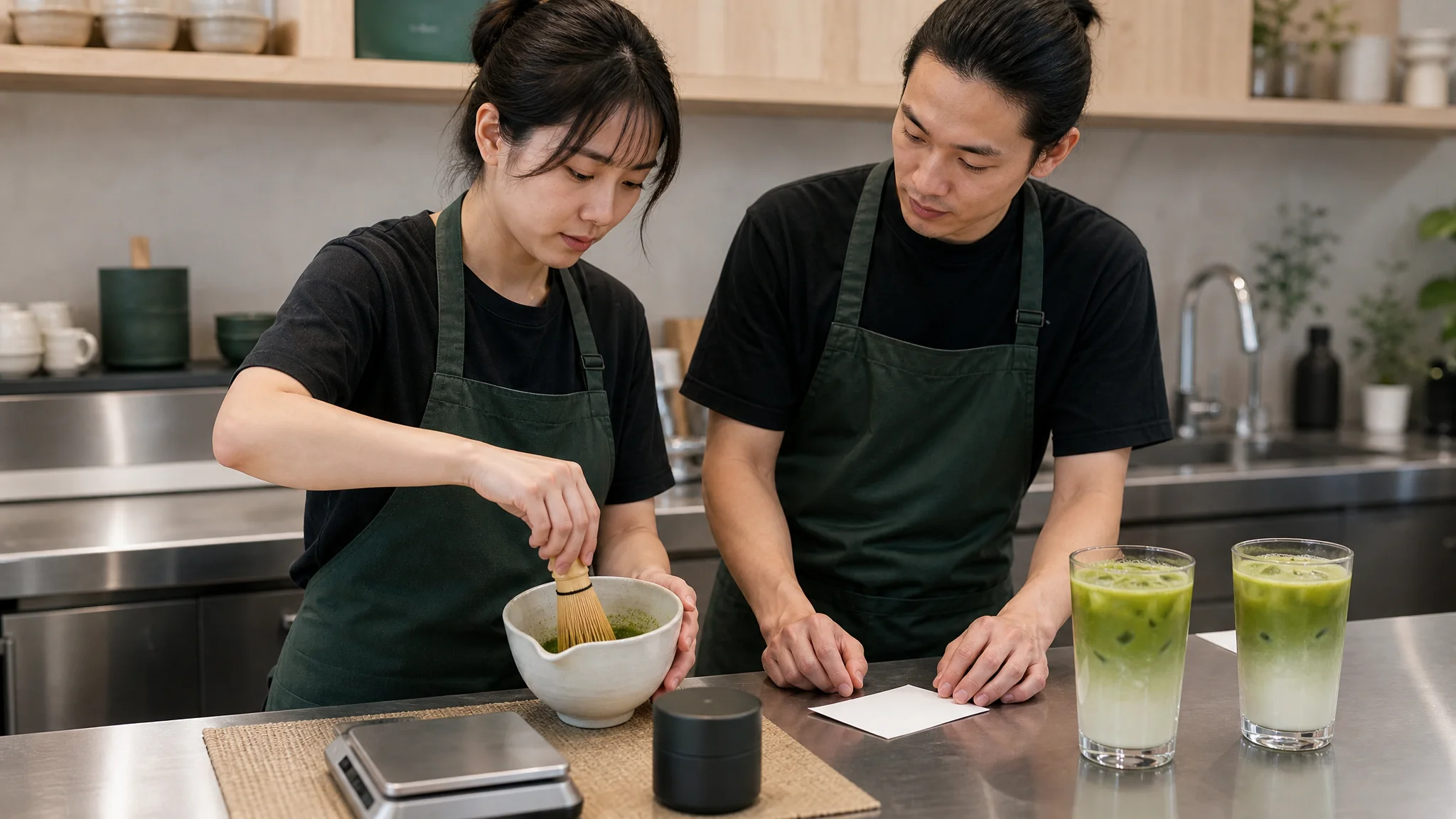
A training session is not complete because someone has watched a demonstration. The operator needs to perform the routine, recognize a failure and know when to stop. Teach a repeatable loop: explain the task, demonstrate it, let the trainee perform it, then ask the trainee to explain the control behind each step. Speed comes after the work is dependable.
Stage 1 / Identify
Read the ingredient label, lot, recipe version and order modification. Explain the dry/wet boundary and the route for used tools.
Stage 2 / Reproduce
Weigh, sift, mix and assemble the approved drink without improvising quantities. Compare its taste and texture with the reference.
Stage 3 / Coordinate
Run mixed tickets with a teammate. Practice spoken exceptions, the handoff limit, refills and temporary equipment loss.
Stage 4 / Recover
Recognize an incorrect milk, missing label, dose error or unsafe hold. Stop, isolate or remake as required and record the cause.
Make the assessment observable
| Competency | What the assessor observes | Evidence to retain |
|---|---|---|
| Recipe and dose | Correct product, tare and quantity; no hidden extra scoop. | Actual measured doses and recipe revision. |
| Dispersion and taste | No persistent dry pockets; reference tea strength, sweetness and texture. | Signed sensory notes, not color alone. |
| Order accuracy | Correct cup, milk and modification; readable handoff identity. | Ticket-to-drink reconciliation. |
| Hygiene and allergens | Correct tool route, label checks and escalation. No unsafe workaround for speed. | Observed checklist and any corrective action. |
| Peak coordination | No unowned cups; clear pause signal and safe replenishment. | Preparation and queue observations from a mixed-order drill. |
Example internal dose exercise: if the shop approves a 3.0 g dose with a 2.9–3.1 g release range, record ten consecutive measured portions. The range and sample count are proposed training settings, not universal requirements. Select a suitable scale and confirm its performance; a display reading to 0.1 g does not, by itself, prove accuracy within 0.1 g. Do not assess precision on an unchecked scale.
Include deliberate exceptions in the drill: a dairy-free request, an extra-matcha order, a missing batch label, an empty syrup bottle and a dropped whisk. An operator who makes a beautiful standard latte but guesses during an exception is not ready to work without support. Food-safety or allergen failures override a fast average time and require corrective training before sign-off.
Teach the diagnosis, not just the correction
If a drink is gritty, check dry pockets, powder condition, mixing method and settling before telling staff to whisk harder. If taste varies from the first batch portion to the last, check suspension uniformity and actual dispensing mass. If a layered drink tastes weak, confirm the tea dose before changing the syrup. Training should prevent random adjustments that make the next shift's recipe impossible to reproduce.
Keep the sign-off with the recipe version. Reassess affected tasks after a product, dispenser, milk or recipe change. A previous pass with different ingredients does not validate a new build. Managers should make error reporting useful rather than punitive: concealed remakes are harder to correct than visible mistakes with a recorded cause.
9. Design storage and cleaning into the workflow
The dry powder, prepared concentrate, opened milk and cooked toppings are different materials with different controls. Do not assign them a shared shelf-life rule because they meet in the same cup. Establish receiving, preparation, cooling where applicable, holding and discard instructions through your local requirements, product instructions and food-safety plan. This guide does not validate a holding period for a particular recipe.
Keep reserve stock separate from working stock
Protect powder from moisture, heat, light and strong odors. Barista Magazine's matcha storage and milk-pairing guidance (May 2025) supports airtight, dark storage and choosing tea in the context of the milk used. That is a useful purchasing and handling principle, not proof of a fixed shelf life after your package is opened.
Replenish a small identified working container from protected reserve stock without bringing the full reserve into the splash area. Follow the supplier's temperature instructions. If reserve powder is refrigerated, address condensation before opening it in a warmer room; ILEM JAPAN's storage guidance (March 2026) specifically discusses allowing a sealed cold container to warm before opening. Avoid repeatedly exposing a cold bulk container during service.
Separate cleaning from a quick rinse
A rinser may remove visible residue, but it is not the entire cleaning and sanitizing process. Follow the approved wash, rinse, sanitize and drying sequence for each food-contact item, including the chemical label's concentration and contact-time requirements where chemical sanitizing is used. Check equipment instructions for parts that need disassembly. Do not immerse an electrical motor body or assume a damaged whisk remains suitable for service.
Plan enough clean tools to allow the required process to happen without shortcuts. A dirty landing and clean storage shelf should be distinguishable even during a rush. Keep food and cleaning chemicals apart. Preserve access to handwashing facilities; powder preparation never justifies using a handwash sink as an equipment rinse station.
Make allergen communication specific
Read ingredient and allergen declarations for every milk, powder blend, syrup and topping. Plant-based does not automatically mean suitable for every allergy. Use the tools and procedures required by the shop's allergen plan, and do not promise an allergen-free drink if shared equipment or ingredients make that claim unreliable. A water-only tea base gives customization flexibility, but it does not eliminate downstream cross-contact.
Use a firm stop rule for missing identification, unknown preparation time or a breached holding control. Do not taste a questionable batch to decide whether to sell it. Appearance and aroma checks assess quality; they do not establish microbiological safety. Route uncertain product to the person responsible for the food-safety decision rather than letting the next barista inherit the problem.
10. Measure saleable output, not just fast hand movements
A faster demonstration is not a stronger business case unless the result survives real orders. Count accepted drinks, remakes, discards and the labor needed for preparation, replenishment and cleaning. For the ingredient-accounting framework, use the matcha cost per cup guide, but populate the model with your current invoices, recipe and measured yield rather than adopting published prices as your quotation.
Direct preparation labor per cup = allocated preparation, service and reset labor cost ÷ accepted cups
Keep units consistent and use the same measurement window in numerator and denominator. If a batch carries over into the next window, account for its remaining usable inventory rather than charging all powder to the first window's sales. Track direct labor separately from ingredient cost before combining them for a contribution analysis; neither figure alone is net profit.
| Metric | Definition | Decision it supports |
|---|---|---|
| Queue time | Production start minus order acceptance. | Whether incoming demand exceeds usable capacity. |
| Start-to-handoff time | Handoff minus production start; include internal waits. | Whether layout or shared resources delay a started drink. |
| First-pass yield | Drinks accepted without remake ÷ total drink builds. | Whether apparent speed creates rework. |
| Powder variance | Inventory depletion minus recipe-based expected use, reconciled for known waste. | Dose drift, batch retention, spills or recording errors. |
| Labor per accepted cup | Allocated labor time ÷ accepted cups. | Whether batching shifts work or actually reduces it. |
| Reason-coded discard | Quantity discarded with identity, time and reason. | Whether forecast, batch size or handling needs correction. |
Arithmetic illustration, not shop performance data: at 3.0 g per cup, 100 accepted drinks require 300 g before waste. If 330 g is actually consumed and there is no uncounted usable stock, powder use is 3.3 g per accepted cup, or 10% above the recipe requirement. The useful next question is where the 30 g went: remakes, spills, retained concentrate, over-dosing or an inventory error.
For waiting time, report a median and a slow-tail measure such as the 90th percentile, alongside the sample size and order mix. Averages can hide a few very slow modified orders. Avoid comparing a quiet weekday trial with a weekend rush and calling the difference a layout improvement. Keep menu mix and staffing comparable, or disclose how they differ.
Troubleshoot the constraint before changing the whole station
- The queue grows before mixing: check weighing, water access and tool availability.
- Prepared tea waits for cups: check milk, ice, topping and sealer access; adding a faster mixer will not fix this.
- Refills interrupt every burst: move protected replenishment closer or change working stock levels, without exceeding safe storage.
- Remakes rise as speed improves: check handoff identity and recipe controls before raising the target again.
11. Purchase for the station's actual recipe and replenishment cycle
A procurement specification should describe the finished drink and the work required to make it. Send the supplier the powder dose, milk base, sweetness, temperature, mixing equipment and intended holding method. Ask for a sample that represents the quoted product and for current specifications, lot identification, relevant testing documentation and ingredient/allergen information. A grade label alone does not tell the operator how the powder will behave.
Test candidate powders through the same preparation method, then compare the finished beverages under controlled conditions. Include opening, weighing, dispersion, flavor in milk, settling, cleaning and usable yield. If the more expensive sample makes the intended drink at a different dose, compare cost per accepted recipe, not just price per kilogram. Do not assume higher price always helps, or that a premium powder is automatically wasted in milk.
Write a usable replenishment calculation
Purchase planning quantity = forecast recipe demand ÷ measured usable yield
Reorder point = expected demand during replenishment lead time + justified safety stock
The usable-yield adjustment already allows for the loss represented by that yield; do not add the same waste percentage again. Safety stock protects against uncertainty, while lead-time demand covers expected consumption. They are different quantities. Align forecast periods, delivery schedules and shelf-life constraints before choosing a larger package.
A small shop may need split deliveries or smaller sealed inner packs more than a headline bulk discount. A chain may need consistent lot documentation and an agreed change-notification process more than another marketing grade. Ask how substitutions, delayed deliveries and specification changes will be handled. Use first-expiring, first-out stock rotation where applicable and keep the lot-to-working-container connection intact.
Put a backup ingredient through a separate approval process. A substitute that needs a different powder dose, milk amount or mixing sequence is a new recipe version. Keep that version available before a shortage occurs; do not let staff compensate for unfamiliar powder with improvised sugar and extra scoops during service.
12. Pilot the new station before making the furniture permanent
Start with a reversible change. Tape out the proposed zones, relocate movable tools and trial the handoff with the existing team. Keep a record of what changed so a useful improvement can be repeated. Expensive fixed equipment should solve a demonstrated constraint, not a speculative one.
Observe the baseline
Record the order mix, staffing, waits, crossings, remakes and refill interruptions. Photograph the old tool positions for comparison, respecting staff and customer privacy.
Run the mock service
Use approved recipes and a mixed ticket sequence. Include cleaning, refills and exceptions instead of timing only the easiest drink.
Release a controlled pilot
Assign the shift lead, recipe version and stop conditions. Monitor quality and hygiene before treating faster output as success.
Standardize what works
Update the station map, recipe card, cleaning plan and training rubric together. Review again after a menu or equipment change.
Opening, rush and closing checks
- Before opening: confirm ingredient identity, stock condition, scale checks, point-of-use water settings, cold-storage controls, clean tools and readable recipes.
- Before the rush: assign roles, stage approved working stock, check the handoff area and confirm the next refill owner.
- During service: follow portion and release checks, watch queue buildup, remix approved batches as specified and record exceptions.
- At close: reconcile usable stock and waste, apply approved discard rules, clean and sanitize equipment, and document what the next shift needs to know.
The operating principle: make the correct action easier to perform and easier to check. A good matcha station shortens unnecessary movement without removing controls. Its success is visible in consistent drinks, understandable handoffs and recoverable mistakes—not in a universal counter dimension or an untested promise of seconds per cup.
Matcha station workflow FAQ
How much counter space does a commercial matcha station need?
There is no universal footprint. Size the station around actual equipment, comfortable reach, door clearances, cleaning access and local requirements. Test dry dosing, wet mixing, assembly and handoff with the staff who will use it before installing fixed counters.
Should a busy cafe whisk every matcha drink to order?
Not necessarily. Compare whisk-to-order, protected dry portions and short-run concentrate batches using your demand, recipe and quality checks. Liquid batching moves work upstream but adds holding, identification, uniform mixing and measured dispensing controls.
How do you calculate the matcha dose in a concentrate?
Divide powder mass by total homogeneous batch mass to find the powder mass fraction, then divide the target powder dose by that fraction. For example, 30 g powder plus 450 g water gives a 6.25% powder fraction; a uniform 48 g portion contains 3.0 g powder if there are no other additions or losses.
How long can prepared matcha concentrate be stored?
This guide does not establish a safe holding period. Set preparation, cooling where applicable, storage and discard limits through your food-safety plan, product instructions and local requirements. Good color, aroma or a supplier tasting trial does not validate microbiological safety.
How should staff be assessed before working the matcha station?
Assess ingredient identification, measured dosing, dispersion, order accuracy, hygiene, allergen handling and recovery from mistakes. Use a current recipe and checked equipment, record the results, and sign off competence before emphasizing speed.
Does adding a second barista double matcha output?
No. Output depends on the slowest task or shared resource. Two people can work in parallel only when equipment access and handoffs support it. Measure the whole line, including replenishment, cleaning and exceptions, rather than adding individual theoretical capacities together.
How should a shop choose matcha for high-volume lattes?
Compare samples in the intended recipe using the same milk, dose and equipment. Assess flavor, dispersion, usable yield, documentation and replenishment needs. Compare cost per accepted drink rather than selecting only by a grade label or price per kilogram.
Build the ingredient specification around your actual station
When contacting AMULYN, share the drink format, approved powder dose, milk choice, equipment, peak demand and replenishment needs. Request a representative sample, current specification and relevant documentation, then validate the sample through the same workflow your staff will use.
Discuss Your Matcha Program


