
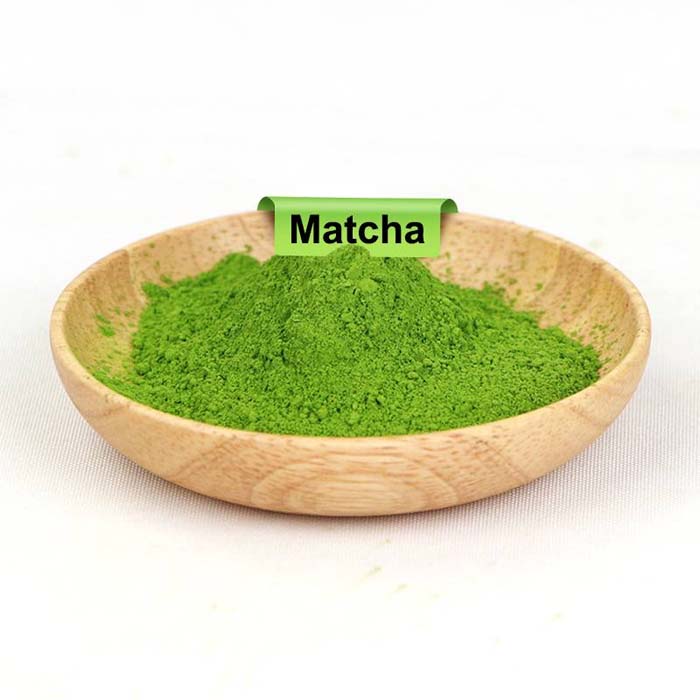





















When a beverage brand expands from a handful of boutique cafes into a multi-unit franchise of 20, 50, or 100+ stores, ingredient procurement undergoes a profound operational shift. At scale, sourcing green tea is no longer about evaluating an isolated 100g sample tin; it is about guaranteeing that 10,000 kilograms of bulk powder delivered across twelve months exhibit zero perceptible drift in color, taste, solubility, or food safety compliance.
Unfortunately, many growing beverage chains fall into the "sample trap." An initial artisanal sales sample appears electric green and sweet, but subsequent commercial shipments arrive with muted olive undertones, sandy particle textures, or unannounced price hikes. Worse, sudden pesticide maximum residue limit (MRL) infractions or stockouts can paralyze store operations and severely compromise brand equity.
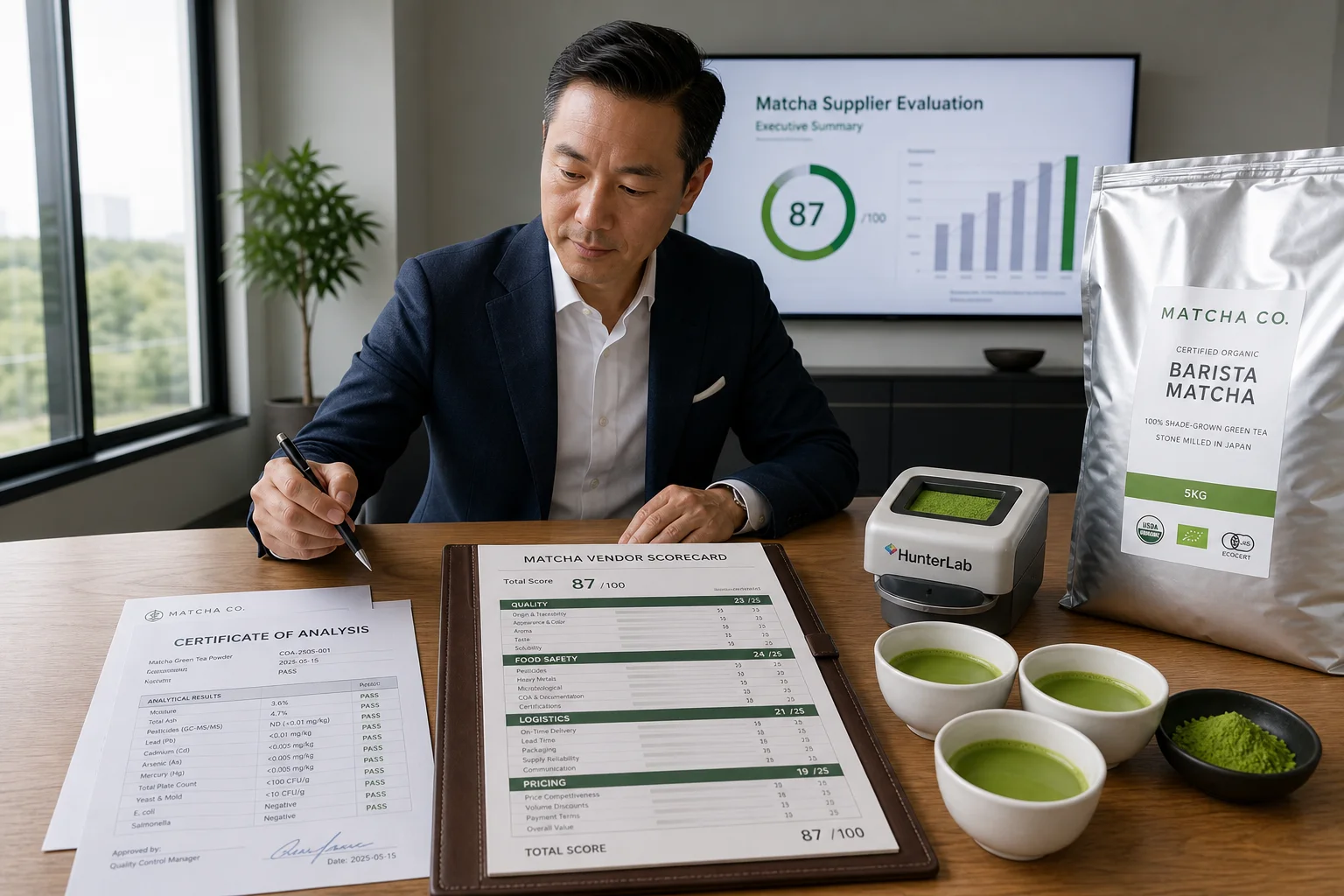
To mitigate these supply chain vulnerabilities, enterprise purchasing directors must replace subjective cupping with a formalized, data-driven 100-Point Matcha Vendor Scorecard. This quantitative framework enforces strict quality control, aligns with unit economics modeled in our matcha cost per cup calculation guide, and secures long-term margin stability.
1. The 100-Point Scorecard Architecture
Evaluating bulk matcha powder wholesale requires decoupling brand marketing claims from verifiable laboratory metrics. The 100-point evaluation structure balances physical product attributes against factory operational resilience.
Where a* must maintain an intense negative green coordinate (a* ≤ -12.0) to qualify as premium Barista Grade A.
2. Detailed 100-Point Scorecard Breakdown Table
Purchasing teams should use this granular scoring matrix during initial supplier onboarding and quarterly business reviews (QBRs).
| Evaluation Dimension | Weight | Target Industry Benchmark Specification | Verification Methodology |
|---|---|---|---|
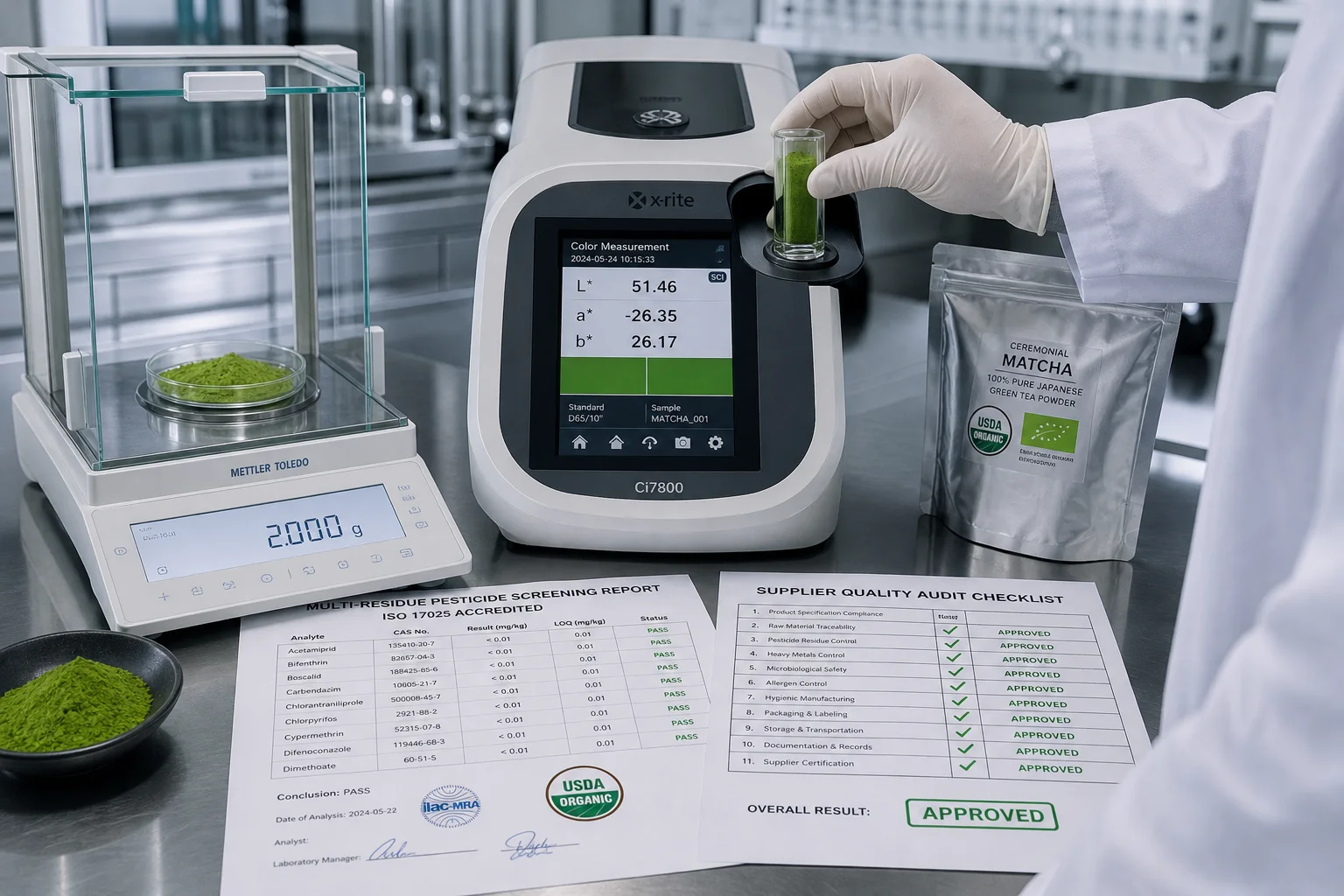
| Color Coordinates (L*a*b*) | 10 pts | a* ≤ -12.0 (Vibrant Green), L* ≥ 50.0, ΔE* ≤ 1.5 across lots | Benchtop Spectrophotometer (HunterLab / Minolta) |
| Particle Fineness (D90) | 8 pts | D90 ≤ 15.0 μm (D50: 5–8 μm), 100% passes 800-mesh equivalent | Laser Diffraction Particle Size Analyzer |
| Moisture & Water Activity | 6 pts | Moisture ≤ 5.0%, Water Activity (aw) ≤ 0.40 | Karl Fischer Titration / Loss on Drying |
| Sensory Profile in Dairy/Oat | 6 pts | Rich umami, low astringency, cuts through 180ml plant milk | Blind Barista Cupping Panel in standard oat base |
| Pesticide Multi-Residue | 12 pts | 100% compliant with EU & US FDA MRLs (500+ compounds tested) | Eurofins / SGS GC-MS/MS & LC-MS/MS Reports |
| Heavy Metal Limits | 8 pts | Pb ≤ 1.5 mg/kg, As ≤ 0.8 mg/kg, Cd ≤ 0.4 mg/kg, Hg ≤ 0.1 mg/kg | ICP-MS Heavy Metal Laboratory Screen |
| Traceability & Facility Audits | 5 pts | FSSC 22000 / ISO 22000, USDA/EU Organic, Lot-to-Garden QR | Third-party GFSI Audit Certificates |
| On-Time In-Full (OTIF) | 12 pts | OTIF Fulfillment Rate ≥ 98.5% over trailing 12 months | ERP Warehouse Receiving Logs |
| Production Capacity & SLA | 8 pts | Dedicated monthly allocation ≥ 10 Tons; 5-day rush SLA | Factory Capacity Audit & Binding Service Agreement |
| Tiered Pricing Transparency | 10 pts | Transparent FOB/DDP volume ladders (100kg, 500kg, 1T, 5T+) | Signed Commercial Pricing Agreement |
| Annual Fixed-Price Hedging | 5 pts | 12-month fixed pricing contract without mid-year surcharges | Master Supply Agreement (MSA) Terms |
| R&D & Custom Blending | 10 pts | Custom shading/blending, seasonal menu engineering support, 24h QA support | R&D Application Sample Turnaround Time |
3. Vendor Tiering Strategy & Procurement Volume Allocation
A standardized scorecard is only effective if directly tied to purchasing allocation. Categorizing suppliers into formal operational tiers eliminates emotional bias and protects supply chain continuity.
Tier 1: Strategic Partner (90–100 Pts)
- Volume Allocation: 70% of total chain purchasing volume.
- Commercial Terms: 12-month fixed pricing, guaranteed safety stock in local warehouse, priority crop allocation.
- Relationship: Collaborative product development for flagship Ube Coconut Matcha and signature drinks.
Tier 2: Qualified Backup (75–89 Pts)
- Volume Allocation: 20% to 30% of total purchasing volume.
- Commercial Terms: 6-month contract terms; deployed across secondary regional clusters.
- Strategic Function: Active operational hedge against primary origin weather failures or shipping delays.
Tier 3: Conditional / Probation (60–74 Pts)
- Volume Allocation: 0% of beverage matcha; restricted to secondary culinary baking ingredients.
- Corrective Action: Mandatory 30-day Corrective Action Plan (CAP) to resolve color drift or delivery lag.
- Threshold: Re-audit within 60 days or face complete de-listing.
Disqualified / Blacklist (<60 Pts)
- Action: Immediate de-listing and termination of open purchase orders.
- Triggers: Any pesticide MRL failure, synthetic dye adulteration, or unauthorized origin blending.
- Enforcement: Automatic 24-month supplier lockout across all brand entities.
4. Red-Line Audits: Pesticides, Heavy Metals & Traceability
While color and taste drive consumer reviews, regulatory compliance protects the business from catastrophic franchise-wide product recalls. Enterprise scorecards must establish zero-tolerance "kill switches" for contamination.
500+ Compound Testing. Require full LC-MS/MS and GC-MS/MS pesticide screening from accredited labs (Eurofins, SGS) for every single commercial production run.
Soil Contamination Audit. Verify that shade-grown tea farms adhere to strict soil chemistry management, keeping lead (Pb ≤ 1.5mg/kg) well below FDA food safety limits.
Shelf-Life Defense. Mandate multi-layer food-grade aluminum foil bags flushed with food-grade nitrogen gas to prevent chlorophyll oxidation and flavor staleness.
Instant Traceability. Scan codes on bulk 1kg/5kg bags to trace raw tencha back to exact harvest dates, farm cooperatives, and steam-processing lines.
5. 4-Step Routine for Implementing Vendor Scorecards
Transitioning your supply chain to a quantitative scorecard requires disciplined cross-functional execution between procurement, quality assurance, and store operations.
Standardize Specs
Define objective physical thresholds (L*a*b* color, D90 particle size, moisture) and attach them to Master Supply Agreements.
Blind Lab Audits
Submit random production samples to third-party labs for independent spectrophotometric and pesticide verification.
Calculate Scorecard
Aggregate quarterly quality, OTIF delivery data, and barista sensory feedback into the formal 100-point rating.
Reallocate Volume
Reward Tier 1 performers with expanded volume while issuing corrective action notices to underperforming vendors.
Conclusion: Systematic Procurement Secures Multi-Unit Scalability
A thriving multi-unit green tea program is built on supplier accountability and scientific rigor. By enforcing an objective 100-point vendor scorecard, beverage brands achieve three decisive competitive advantages:
- Flawless Sensory Uniformity: Ensure that an iced latte ordered in New York, London, or Tokyo delivers the identical vibrant emerald hue and smooth umami taste.
- Bulletproof Food Safety: Eliminate pesticide and heavy metal compliance risks through mandatory lot-by-lot accredited laboratory verification.
- Resilient Cost Control: Protect bottom-line profits against origin agricultural price volatility through structured multi-vendor volume hedging.
By partnering with established direct-from-origin primary producers who provide transparent COA documentation, consistent high-yield milling, and reliable volume scaling, beverage enterprises build a future-proof foundation for sustained global growth.
Matcha Vendor Scorecard FAQ
What are the core evaluation categories in a commercial matcha vendor scorecard?
A comprehensive 100-point commercial matcha vendor scorecard evaluates five weighted categories: Physical & Chemical Quality Consistency (30 pts), Food Safety & Regulatory Compliance (25 pts), Supply Chain Reliability & OTIF Logistics (20 pts), Unit Economics & Price Stability (15 pts), and R&D Technical Support (10 pts).
How is visual color consistency objectively measured across bulk wholesale matcha batches?
Visual color consistency is measured using benchtop spectrophotometers across Hunter Lab or CIELAB color space, requiring an intense negative green coordinate (a* ≤ -12.0) and a strict total color variance (ΔE ≤ 1.5) between production lots to prevent perceptible visual shifting across retail stores.
What particle size distribution is required for high-volume commercial matcha applications?
Commercial cafe and boba chain applications require micro-milled matcha powder with a laser diffraction particle size of D90 ≤ 15 microns (D50 of 5 to 8 microns), ensuring rapid cold-water dispersion, silky micro-foam suspension, and zero gritty sediment in iced drinks.
What is the recommended multi-supplier volume allocation for multi-unit beverage chains?
Beverage chains should maintain a dual-vendor strategy: allocating 70% of total purchasing volume to a primary Tier 1 strategic supplier (scoring 90+ points) while awarding 20% to 30% to a qualified secondary Tier 2 vendor to hedge against origin crop failures and regional logistics disruptions.
How often should enterprise procurement teams audit their active matcha vendors?
Procurement teams should conduct quarterly quantitative scorecard reviews combining lot-by-lot Certificate of Analysis (COA) cross-checks, random third-party pesticide screenings, and trailing 90-day On-Time In-Full (OTIF) fulfillment rate audits.
Why is lot-by-lot batch-to-field traceability essential when sourcing bulk green tea powder?
Batch-to-field traceability links every bulk foil bag back to specific tea garden plots, shading dates, and milling lots, enabling surgical recall containment and immediate verification against 500+ pesticide residue standards without shutting down entire franchise networks.
Partner with a Tier 1 Certified Global Bulk Matcha Supplier
AMULYN delivers certified organic and high-grade barista matcha powders directly from origin tea gardens to international beverage chains. With standardized Hunter Lab color consistency, laser-milled fineness (D90 ≤ 15μm), ISO 22000 certification, and full lot traceability, we power reliable, high-margin green tea programs worldwide.
Request Commercial Audit Spec Sheet


