
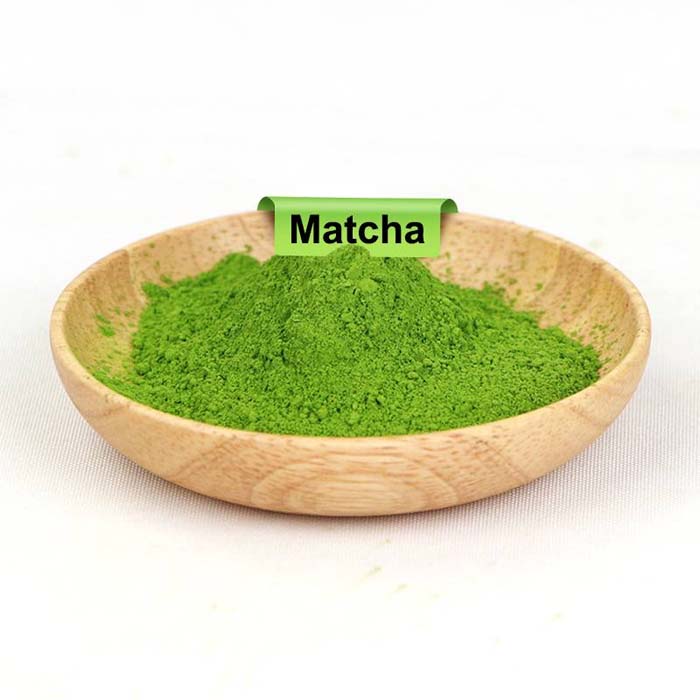






















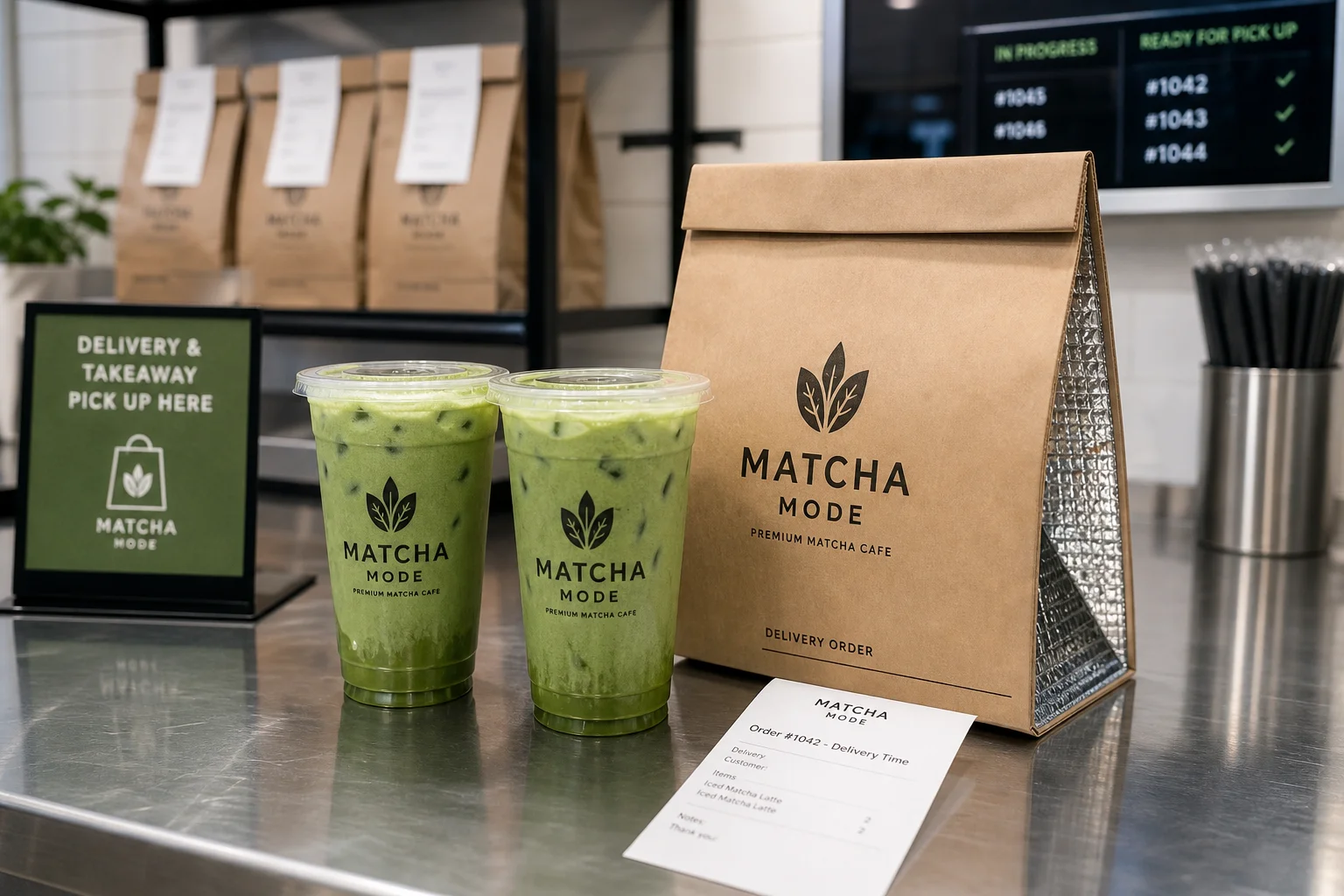
In modern tea franchise and fast-casual cafe operations, delivery platforms (DoorDash, Uber Eats, Meituan, Grab) now represent 35% to 55% of total beverage transaction volume. Yet, while iced lattes and espresso-based drinks travel reasonably well, matcha is notoriously the most fragile beverage on the third-party delivery menu. A drink that looks stunning on the dine-in counter—with crisp layered separation and vibrant emerald froth—frequently arrives at the customer's doorstep 30 minutes later as a muddy, separated disaster with sandy brown silt settled at the bottom.
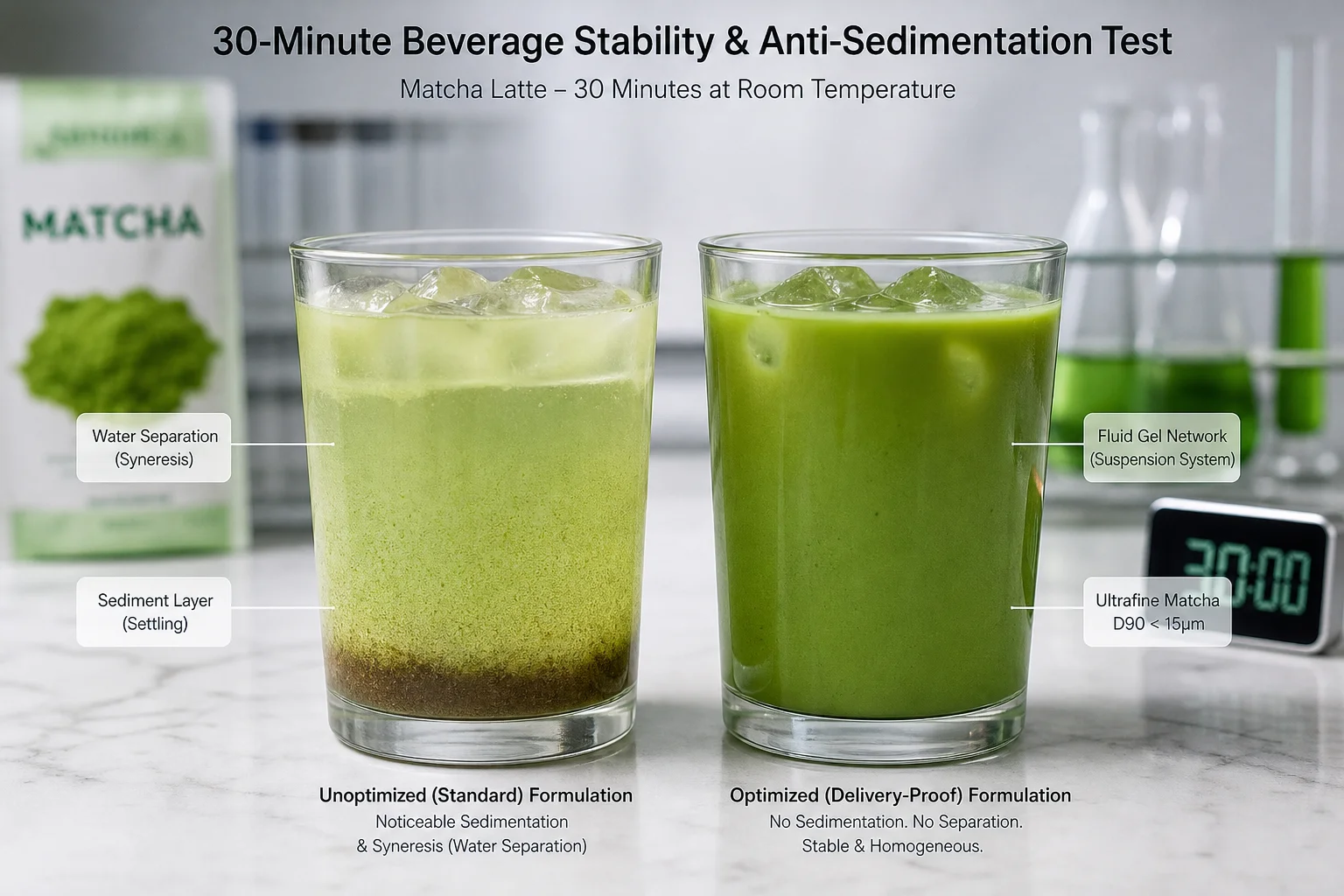
This customer satisfaction failure is rooted in fluid dynamics: matcha is not a water-soluble extract, but a physical suspension of whole, micro-milled tea leaf solids. During courier transit, road vibrations accelerate particle sedimentation, hollow ice melts rapidly and waters down beverage body, and atmospheric exposure turns the top layer olive-brown.
Protecting the premium profit margins engineered in your matcha cost per cup calculation guide requires an intentional transition from traditional dine-in preparation to food-science-backed delivery formulation. By combining ultra-fine milling, natural hydrocolloid yield-stress networks, dense ice geometry, and airtight induction packaging, multi-unit chains can deliver cafe-quality matcha that survives 30 to 45 minutes of transport with zero sediment fallout.
1. The Fluid Physics of Delivery Sedimentation (Stokes' Law)
The rate at which suspended tea particles precipitate to the bottom of a takeaway cup is dictated by Stokes' Law of Gravitational Settling. Understanding this equation explains why standard culinary matcha fails during delivery.
Where: $r$ = particle radius, $\rho_p - \rho_f$ = density difference between tea solids and liquid base, $g$ = gravity, $\eta$ = dynamic fluid viscosity.
Crucially, settling velocity is proportional to the square of the particle radius ($r^2$). If a chain uses low-cost culinary powder with an average particle size of $30\mu\text{m}$, tea solids fall 9 times faster than ultra-fine ceremonial-grade powder ($10\mu\text{m}$). Within 12 minutes of moped vibration, the coarse particles form a dense, unpalatable sludge at the base of the cup.
2. 5 Engineering Strategies for 30-Minute Delivery Stability
To eliminate sedimentation and preserve sensory quality across long delivery routes, R&D teams must deploy these five formulation controls.
01 Particle Size ($D90 \le 15\mu\text{m}$)
- Source exclusively bulk matcha powder wholesale milled via ceramic ball-mill or granite stone.
- Ensure $D90 \le 15.0\mu\text{m}$ ($D50 \approx 5–7\mu\text{m}$) to minimize $r^2$ settling momentum.
- Delivers silky mouthfeel with zero gritty throat-catch.
02 Fluid Gel Network
- Add 0.02%–0.04% low-acyl gellan gum or 0.05% xanthan gum to the liquid base.
- Builds a static 3D yield-stress network that holds tea solids permanently suspended.
- Shear-thinning property ensures light, non-slimy drinking texture.
03 Anti-Melt Solid Ice
- Eliminate hollow crescent or flaked ice; mandate dense solid square cubes.
- Reduce ice ratio from 50% to 30%–35% total volume.
- Reduces meltwater dilution by 55%, preserving sweetness and body.
04 Deconstructed Pouch
- For layered drinks like Ube Coconut Matcha, package milk & ice in the main cup.
- Provide pre-whisked matcha in a separate sealed squeeze pouch.
- Customer pours on arrival, delivering 100% cafe visual layering.
3. Formulation Matrix: Dine-In vs. Delivery Benchmarks
This formulation table contrasts standard dine-in specifications with delivery-optimized recipe parameters for a 16oz (480ml) iced oat milk matcha latte.
| Recipe Component | Standard Dine-In Formulation | 30-Min Delivery-Proof Formulation | Technical Function & Benefit |
|---|---|---|---|
| Matcha Powder Grade | Standard Barista Grade ($D90 \approx 25\mu\text{m}$) | Ultra-Fine Barista A ($D90 \le 14\mu\text{m}$) | Reduces Stokes settling velocity by 78%; eliminates sandy bottom sludge. |
| Hydrocolloid Stabilizer | 0.00% (Pure Liquid) | 0.03% Low-Acyl Gellan Gum + 0.05% Xanthan | Forms yield-stress suspension network; prevents particulate precipitation. |
| Liquid Base Emulsification | Light Whisked Layer Float | High-Shear Fully Homogenized Base | Prevents road-vibration turbulence from creating muddy brown streaks. |
| Ice Geometry & Ratio | 50% Hollow Crescent Ice (140g) | 30% Dense Solid Cube Ice (85g) | Slows melting rate by 55%; prevents watery flavor collapse. |
| Lid & Packaging Seal | Plastic Straw-Slot Snap Lid | Heat-Sealed PP/PE Induction Film Lid | 100% leak-proof; blocks oxygen infiltration and preserves emerald hue. |
| Pre-Chill Liquid Base | Room Temp Milk (~15°C poured over ice) | Pre-Chilled Liquid Base (2°C to 4°C) | Minimizes initial thermal shock melting when ice is introduced. |
4. Troubleshooting Takeaway Quality Failure Modes
When customer review ratings drop on delivery apps, use this root-cause diagnostic chart to audit store execution.
5. 4-Step Standardized Delivery Packaging SOP
Incorporate this rapid packaging line routine into your daily matcha station workflow and bar layout.
Pre-Chilled Dispense
Pour pre-chilled 2°C milk and stabilized matcha concentrate into the cup; homogenize with high-speed immersion blender for 3 seconds.
Solid Cube Addition
Add exactly 4 to 5 dense solid square ice cubes (30% volume ratio) to maintain temperature without rapid melting.
Automated Heat Seal
Pass cup through automated film sealing machine; verify complete 360-degree hermetic seal with zero edge micro-gaps.
Thermal Bag Pack
Place sealed cups in insulated cup-holder bags alongside cold delivery items; dispatch immediately to courier pickup racks.
Conclusion: Engineered Delivery Secures Repeat Platform Revenue
In the competitive delivery landscape, customer lifetime value (LTV) is decided by the sensory condition of the beverage upon unbagging. A delivery drink that maintains uniform emerald brilliance, rich umami sweetness, and silky micro-suspension turns first-time delivery users into weekly subscription-like repeat buyers.
By enforcing precise particle milling , hydrocolloid rheology, solid ice discipline, and robust in-store matcha cold chain and counter storage handling, multi-unit chains turn their delivery channel from a quality hazard into a predictable high-margin growth engine.
Matcha Delivery & Takeaway Formulation FAQ
Why do traditional matcha lattes separate and settle during 30-minute delivery?
Matcha is a non-soluble suspended tea leaf particulate governed by Stokes' Law of sedimentation, causing coarse particles over 20 microns to precipitate to the cup bottom within 10 to 15 minutes, while melting ice dilutes liquid viscosity and courier transit vibration destroys delicate layered aesthetics.
What particle size specification is required to prevent matcha settling in delivery drinks?
Delivery-grade matcha requires an ultra-fine particle size of D90 under 15 microns (D50 around 5 to 7 microns), which reduces gravitational settling velocity by over 75% compared to standard culinary-grade powders, enabling sustained suspension in dairy and plant milks.
How do natural hydrocolloids stabilize takeaway matcha without creating a slimy mouthfeel?
Adding 0.02% to 0.04% low-acyl gellan gum or 0.05% xanthan gum builds a microscopic 3D fluid-gel yield-stress network that holds tea particulates suspended while static, but exhibits rapid shear-thinning during sipping to deliver a clean, crisp, and refreshing mouthfeel.
What is the best product architecture for delivering high-margin layered matcha drinks?
The deconstructed shot-pouch format provides the highest delivery quality: fresh cold milk and ice are sealed in the main cup, while concentrated whisked matcha is packaged in a separate sealed side pouch for the customer to pour fresh upon arrival, preserving 100% visual layering.
How should ice ratios be adjusted for 30-minute delivery matcha drinks?
Replace standard hollow crushed ice with dense solid cube ice (30% to 35% total cup volume) or chill the beverage base to 2°C before pouring, cutting ice melt dilution rates by over 50% across 30 to 45 minutes of courier transport.
What cup sealing method is necessary for third-party courier delivery?
High-volume delivery operations require automated heat-sealed PP/PE film lids with ultrasonic induction sealing, which completely eliminates liquid leaks, blocks atmospheric oxygen infiltration, and prevents vehicle road vibration from causing liquid sloshing.
Source Ultra-Fine Delivery-Grade Wholesale Matcha
AMULYN specializes in ceramic-milled, ultra-fine wholesale matcha powders ($D90 \le 14\mu\text{m}$) and custom-blended botanical suspension formulations. Engineered specifically for high-volume delivery channels, our powders ensure zero-sediment dispersion, vibrant emerald color stability, and maximum margins across 30-minute transit times.
Request Delivery Formulation Sample Kit


